Saturday, September 19, 2020

Hidden Deep in the Woods

                Two hundred and five years ago, this area was a thriving center of activity. People were chipping on stones, cutting them into shape to lay them into walls and to make a furnace, built into the sides of the steep hills. Dirt roads would have been cleared to allow wagons filled with supplies and men to easily access the area.  Buildings would have been built to protect the equipment to house the support facilities such as food and an office for the owner and the bosses to work from.

                Now, the area is quiet, the only sounds noticeable are of the stream running through the valley and the birds, that and the occasional tree falling down. Frank and I were hiking into the site of the old Center Iron Furnace. Built in 1815, there are still a few walls and remnants of what used to be there. It would be our second trip into it, my third. (This furnace is sometimes incorrectly called the Dunbar Furnace which actually sat closer to the town of Dunbar)

                After the furnace was built, workers would be working on chopping down trees and digging for coal and iron ore to put into the new furnace.  Running an iron furnace was a multi-man job, not to mention a 24 hour a day, seven day a week operation. There were a lot of jobs that needed done. The valley would have been filled with smoke and the sounds of industry.

                Iron furnaces were only operational for a short while. Some only lasted a couple years, especially the older ones. Some of the later furnaces lasted for decades.  The life of an iron furnace would be determined by the availability of the ingredients necessary for making the iron. Coal, limestone, trees and of course, iron ore would be needed. A lot of furnaces in Pennsylvania were shut down because all the trees in the area had been cut down to make charcoal.

                It eventually became cheaper to build another furnace rather than shipping the supplies in. When building another furnace they could incorporate newer technologies. They could also build it in a more advantageous spot, closer to roads and other forms of transportation and also closer to other faculties that would use the ingots they made.

                Once the furnace was shut down the owners would remove any useful equipment and then the furnace was left to nature. Quiet returned. Any wooden buildings would eventually rot away; no foundations would have been built since the furnace's lifetime was so short.  Any sign of these buildings disappeared over the years. Stones from the furnaces were scavenged for foundations and walls.

                At this site, the waters of the stream knocked down most of the furnace. The stones here fell into the stream and were pushed away as time marched on. Newer furnaces were built out of stone that had been cut to size and were built further away from the destructive forces of flowing water.  Water was an important part of furnaces; it powered bellows which helped increase the heat of the furnaces. Most of the earlier furnaces are now nothing but piles of rubble, Mother Nature having worked her magic on them. Rain, snow and the roots of trees are marvelous tools for destroying stonework!

                This site, at the juncture of the Glade Run and the Dunbar Creek is where the remains of the Center Furnace lies. Built in 1815, it is one of the earliest in this area. The furnace was built into the hillside. Stacked rocks can be seen but most of it has been washed away by the stream. Beside the remains of the furnace is a nicely built stone wall. There is an opening behind it, between it and the hillside. I am guessing it might have been a waterway. There are nice square corners on it, still sharp after all these years.


                On the hillside above the furnace, about 30 yards up the steep hillside are the remains of the charcoal house. Built out of fieldstone and into the hillside, it is amazing to see how much of it is still standing. This structure is very similar to the charcoal house standing near the Alliance Furnace on Jacobs Creek.      https://bookman56.blogspot.com/2020/08/walkin-into-past.html

                The front wall is approximately 50-60 feet long with an opening at the end nearest the furnace. Two walls at either end, each about 20 feet long work into the hillside. The fourth wall is the hillside itself.

                Trees are growing inside the structure. The walls are various heights with the far corner the highest, approximately 15 feet high. Stones are missing in many places and some are hanging off the top, waiting for nature and gravity to do its work.

                I can’t help but be impressed that these structures are still standing after over 200 years! Was it good construction techniques or was it the absence of visitors who might harm or destroy the site?

                We will be back! There was what looked like a cave near-by that Frank found and on an earlier visit, I saw a stone lined trough in the valley across from the furnace. My curiosity is calling me back! We were both tired when we got back to the truck but this soon passed. Not bad for two old guys! We were both satisfied with our hike and what we saw and we both have the idea of a future visit festering in our minds.

                Till then, the ruins remain hidden deep in the woods.

Sunday, September 6, 2020

Off to the Library and an Iron Furnace


The day was beautiful, the sky blue and the temperatures were perfect for being outdoors. That was exactly what Ann Marie and I had in mind.

                I had read on-line that the Carnegie Libraries were open! Can you believe it? After nearly a half year they have finally reopened again! I called a local library and was told that they were still closed. So, it looked like AMB and I were heading towards Oakland and the Main Branch.

                We stopped at City Books to say “hello” to our friend Arlan, the owner, on the way. We stood in the door and talked to her behind the counter. There were customers in the store so we stayed outside. The store limit is currently four customers at a time. By staying outside we allowed the paying customers to go inside.
                While we were there, two girls and their mother brought some books up to the counter to buy. There were three Nancy Drew books amongst them. While checking the prices on the inside cover, Arlan discovered that one of them used to be hers. It was given to her for her birthday by her best friend! (“She had red hair!”) I always think it is cool to find out some of a books provenance, if it were me, that book would become special because I knew its background! I had met the person who owned it before me!
                The three of us discussed a couple books and Ann Marie put one on order. We discussed some astronomy stuff that would be happening later in the evening and then, as more customers showed up, we left for our next stop…the Library!
                In Oakland, we found a parking spot a short distance away from the library, right in front of Caliban Books. Since we were there, we stopped in. This store has a 6 person limit. The door was locked, we had to knock to be allowed inside. I’d tell you the “secret knock” but you know what I’d have to do if I told ya!
                We wandered around a bit, listening to the conversation between a customer and the salesman. We couldn’t help but hear it; there was no one else there. So we ended up adding our own two cents a couple times. We both found something to take with us. Putting the books in the car we walked over to the library.
                Walking around Oakland we saw lots of students laying out in the grassy lawns and swinging in hammocks strung between trees, sitting together in groups on the walls and playing Frisbee and softball. Ann Marie said it felt like we were walking through Ground Zero. Masks were both on and off, we felt a little nervous.
                Arriving at the main entrance of the library building, there was a tent set up outside of it. A young woman sat under it and asked us how she could help us. We told her that we’d like to go in and look around to which she replied that it was only open for computer use and to pick-up books that had been ordered. That and the restrooms were open. Of course we were upset, we had been led to believe that they were open for business. There wasn’t much we could do about it. They were open, just not for what we wanted to do in it…use it as a library, look at and get some books! Instead we settled for a quick visit to the bathrooms.
                It was sad, employees stood around directing us where to go and making sure we didn’t go anywhere else. We looked into the main room, the shelves filled with books that we couldn’t touch.
                Returning outside, we took a short walk around the area and then returned home. Some beers and a game of Scrabble welcomed us back. We sat under the tree out back and ate chicken sandwiches covered with homemade BBQ sauce on fresh bread, drank a few beers and played our game. (AMB beat me by 100 points!)
                Later tonight the moon and Mars will be rising together, we had a nice drive around the city this afternoon and the weather has been wonderful, the holiday weekend is turning out pretty nice, even though we will have to wait a bit longer before we will be able to browse the racks again!

Moon and Mars- 11:24PM, 9/5/20
                Monday morning, Labor Day, the two of us headed south to West Virginia. (Sounds a bit odd doesn’t it?) We visited Coopers Rock State Forest where we walked on the edges of high cliffs and then hiked down to see the remains of the Henry Clay Iron Furnace. It was only a mile downhill on a rocky dirt road, to tell the truth, going up was easier than down, as far as my knee was concerned.  It was nice being in the shade while we hiked, we found it quite enjoyable.
Our first view of the furnace
                The Henry Clay Furnace was built between 1834 and 1836 and operated until 1847. While it was in operation it employed about 200 men. There were about 100 houses, a church, a school and a store. Now, about 173 years later, nothing remains of this industrial complex except the stack of the furnace. The buildings that stood around it to support the process of making iron have all disappeared over the years, leaving this pyramidal structure sitting alone in the woods.
                The corners have a step like edge because the stones were cut as rectangles. On other furnaces we have seen, the stones on the ends were cut on an angle to match the sides. There are a fair amount of cracks visible in its sides but it still stands strong!
Inside the stack
                On our trip we stopped at an antique and book dealer we had read about. Sadly the store was closed.  Maybe the next time! We returned home about 8 hours after we left and the rain started not soon after. All in all, it was a wonderful weekend!


Thursday, September 3, 2020

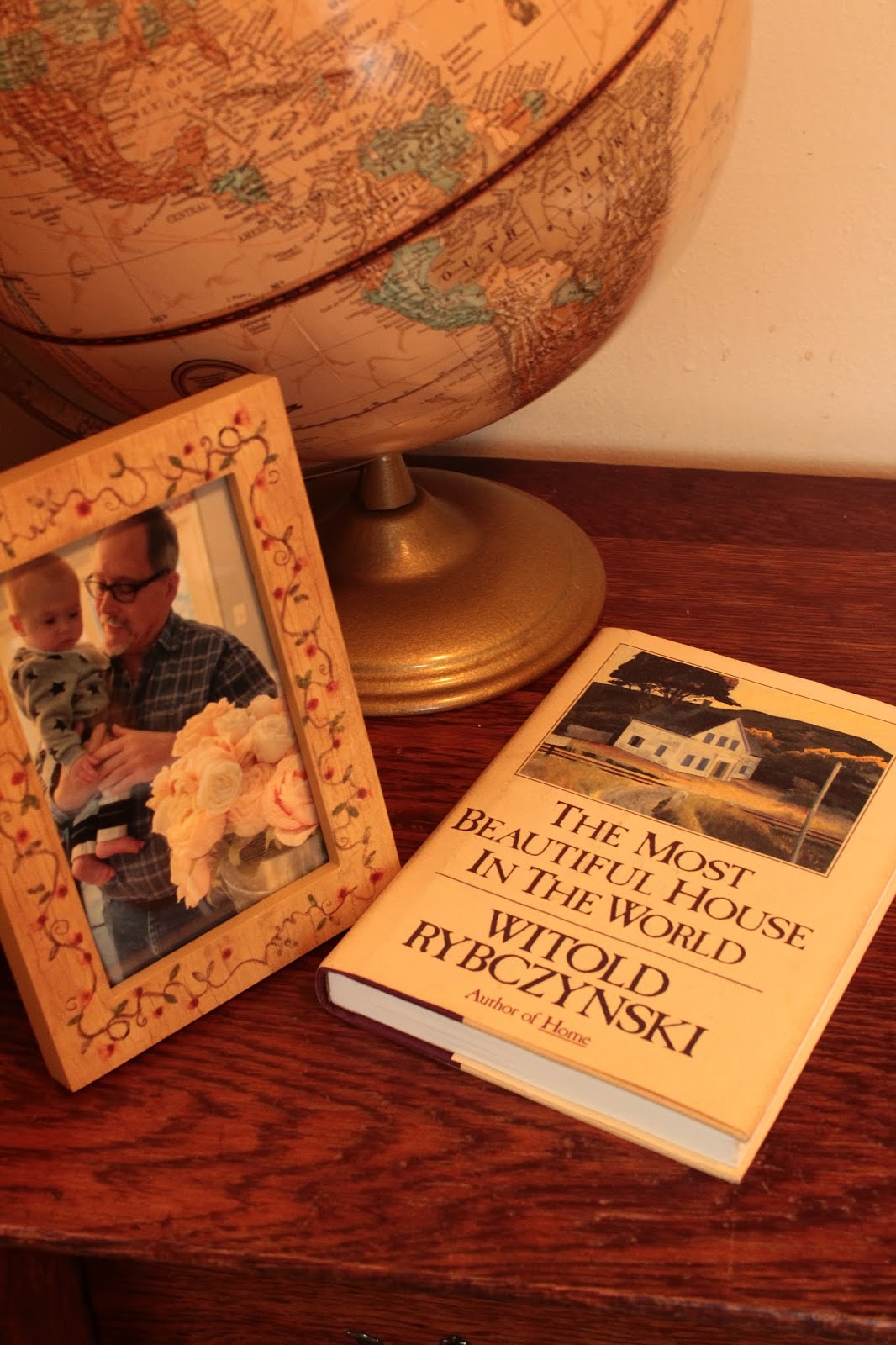
The Most Beautiful House In The World

                Every so often I find a book that is exceptionally good, to me at least. A couple weeks ago while rummaging through a couple boxes of books at my favorite book store, (City Books) I came across a book with a nice looking dust cover, pebbled paper with a watercolor of a house on it. It was entitled The Most Beautiful House in the World. It was written by Witold Rybczynski. (1989) The paper was ivory colored and there were small pencil drawings that accompanied the story. I added it to my pile, never realizing that it would be the best book in the pile.

                At home, I started looking through the books reading a little bit of each of them. When I picked up this book, I stuck with it until I had finished it. The others were forgotten.

Witold had a vision of building a boat, something a bit larger than a row boat or a canoe, something seaworthy. He had spent years drawing up designs, changing them as his desires changed. He decided that he would need a place to build this craft and so, being an architect he started designing a boat house.

                This wonderful book takes from his early days of designing his boat through the design and construction of a place to build it and eventually, the changing of the shop into a home. As he tells this story, he also tells us about how buildings are designed and how they are made to fit into the neighborhood He also explains how some designers make buildings which don’t fit into the neighboring structures. He tells to us how cathedrals are basically just large barns. He explains about feng-shui and how it is important to make a house that fits into the landscape, spending 5 or 6 pages describing it and giving examples. He tells us about famous architects and how they put their ideas onto paper and eventually into the ground.

                While he builds his shop, he changes his ideas about how it should be built frequently. This is all part of the process of designing a proper building. Usually when he is working he is filling someone else’s desires and this can become frustrating, not so much for him who needs only an eraser and a pencil to change things, but for the builders who might have to remove something already built. There are times while building his boathouse when he has to do just that.

                In the end, once the shop has been built and he drags out the boat plans he had drawn years ago, he realizes that he no longer wants to build a boat, he has already built something with his hands, the shop. He and his wife decide to change it into a house.

                During this process, he explains the things that make a house a home. It isn’t so much the size, shape or design of the building as it is the way it is lived in. He writes about how houses are personalized and eventually start to resemble their owners. He takes us to a small house built by a man in Los Amusgos, Mexico. The place was small and it started out just a concrete slab in a tight community. The owner and builder slowly started with walls and a roof, some of the walls just plastic. Over time the house became more solid and the outside was decorated with plants, spices and flowers which helped give the house a lived in look and also shielded it from the street that sat beside it. The inside was decorated with pictures of the children and by the children. Over time, the house was personalized. The house is still being built, it is a process in the works but still, it is a beautiful house, it is a home!

                In this book Witold has taken us to Ludwig’s castle, Neuschwanstein, Frank Lloyd Wright’s Fallingwater, a small house in a crowded city and to his own house, not to mention many, many others.  Cathedrals through barns, he covered it all. In the process he explains quite elegantly how a house becomes a home.  Witold also has a great way of tell a story, it was a book I didn’t want to end!

Not only that but the copy I got really looks and feels nice also, I put those things high as part of my appreciation of books!

Looking into the Past

“9/26/90- Fog, everywhere but up”      I have been searching through my slides and pictures for shots taken at the Wagman Observatory and ...