Showing posts with label Allegheny Observatory. Show all posts

Sunday, September 29, 2024

What a Wonderful Combination

Sitting on a set of cold hard marble steps, I paged through a 1910 version of Norton’s Star Atlas. The steps were far from comfortable but I wasn’t complaining. I was happy to be where I was.

    It was Friday night and I was helping out as a volunteer for the Allegheny Observatory’s open house. My chore was to direct the various groups of visitors between the 13” Fitz-Clark refractor and the next stop, an explanation by some students of how the new Keeler scope was being used for research. I was positioned at the top of the three-story set of marble steps leading up to the telescope. Beside my perch was a small set of steps which I was using as a seat between tours.

    At the top of these three steps was the entrance to the second balcony of the observatory’s library. Inside the door was a narrow balcony lined with books and journals. A thick pipe railing surrounded the opening. Three stories below was a gentleman describing and showing videos of the April total solar eclipse. Above was a glass ceiling. No light was coming through it but in my mind, the shelves were glowing!

    After directing a group into the dome of the 13” refractor, I had about 20 minutes on my hands before the next group arrived. In those minutes, I talked with other volunteers and walked around a bit, peeking through windows to see what I could see. I also went into the library and explored the bookshelves!

    The books on the third floor were a collection of various subjects. Placed in alphabetical order by author, I was taken for a journey between astronomy, the workings of light waves, the design and manufacturing of optics all the way into machine shop practices. There were also numerous volumes written in languages I couldn’t understand.

    Being a machinist by trade I started out with a book about jigs and gages written in 1901. Books such as this are always fascinating to read. Having line drawings of old machinery and equipment, they are filled with lots of rich information which often isn’t passed on to new machinists these days. It is information which is usually picked up through years of experience. There are mentions and examples of tools and tooling which are no longer used in the modern machine shops because of the advancements of technology. 

    From there I headed into the field of astronomy. Since this library was in an observatory most of the books dealt in some way or another in that subject. I would remove a book from a shelf, being careful not to damage any fragile binding or covers, open it slightly and peruse the pages. If it interested me, I’d mark the spot it came from and go and sit down and read for a bit.

    The Norton’s Star Atlas I mentioned before was one of the ones I had taken down. I have a copy of this book at home, written in 1989. I use it quite often. My copy was bought in 1990 and I had inscribed on the first page that the first observations using it was at 5AM on March 3rd, 1990.  I was observing in Sagittarius. It also says, “It was a beautiful, warm morning, the way they all should be!” The 1910 version in the library was a lot thinner than my copy and it doesn’t have any of the glossy pictures that mine has but it does have the great sky maps.


    I also looked at a book called “Astronomy by Observation” written by Eliza A. Bowen. Written in 1890 it has some photos of plaster reproductions of craters on the moon made by Nasmyth and Carpenter. Listed on its’ back cover are an assortment of scientific books ranging in price from 60¢ to $5. Sadly, the price of books has risen just the same as groceries.

    I went in and listened to some of the talk about astronomy and the history of the 13” telescope. One of the stories told was about the time that the lens for the scope was stolen and held for ransom.


    The telescope was built in 1861 by Henry Fitz and was installed in the original Allegheny Observatory. (It was later moved to its present location in the new observatory in 1906) When it was built it was the third largest telescope in the country! In 1872 the lens was stolen. A note demanded money but the observatory director, Samuel Langley wouldn’t pay. He figured this would only lead to more “lens-nappings”. The glass was eventually recovered in a hotel in Beaver Falls. The lens had a large scratch on it and it was shipped to Alvan Clark to refigure and polish. This ended up making the lens even better than it was before it was stolen! Ever since the lens has been replaced in the scope it has been known as the Fritz-Clark telescope.

    Another book I looked at was called “The Elements of Theoretical and Descriptive Astronomy” written by Charles J. White. It was published in 1872. What makes this book special was that it had been owned by Samuel Langley! His signature was on the first page! To think I was holding a book once owned, signed and read by this important man was extremely exciting.

    I get the same feeling when I think that John Brashear walked in these same corridors and climbed the same steps where I was stationed! This building is living history!


    Once the last group had passed by I started saying my good-byes. I stopped in the basement and saw a glass negative taken using the 30” Thaw refractor. Just barely visible are two faint dots. This is a picture of the planet Pluto. The picture was taken on February 16th, 1953. This negative was taken 23 years after the planet was discovered. The reason there are two dots on the negative is that they would take a picture and then move the scope a slight bit and then take another shot. This was helpful in determining the exact position of the object they were observing. History, isn’t it exciting?

    Talking with the people who run this facility, the students that do their studies and research here along with the various volunteers who helped pull this event off was a learning experience. There is so much to learn when talking with them; I can only hope that at least a little bit of their knowledge rubbed off on me!
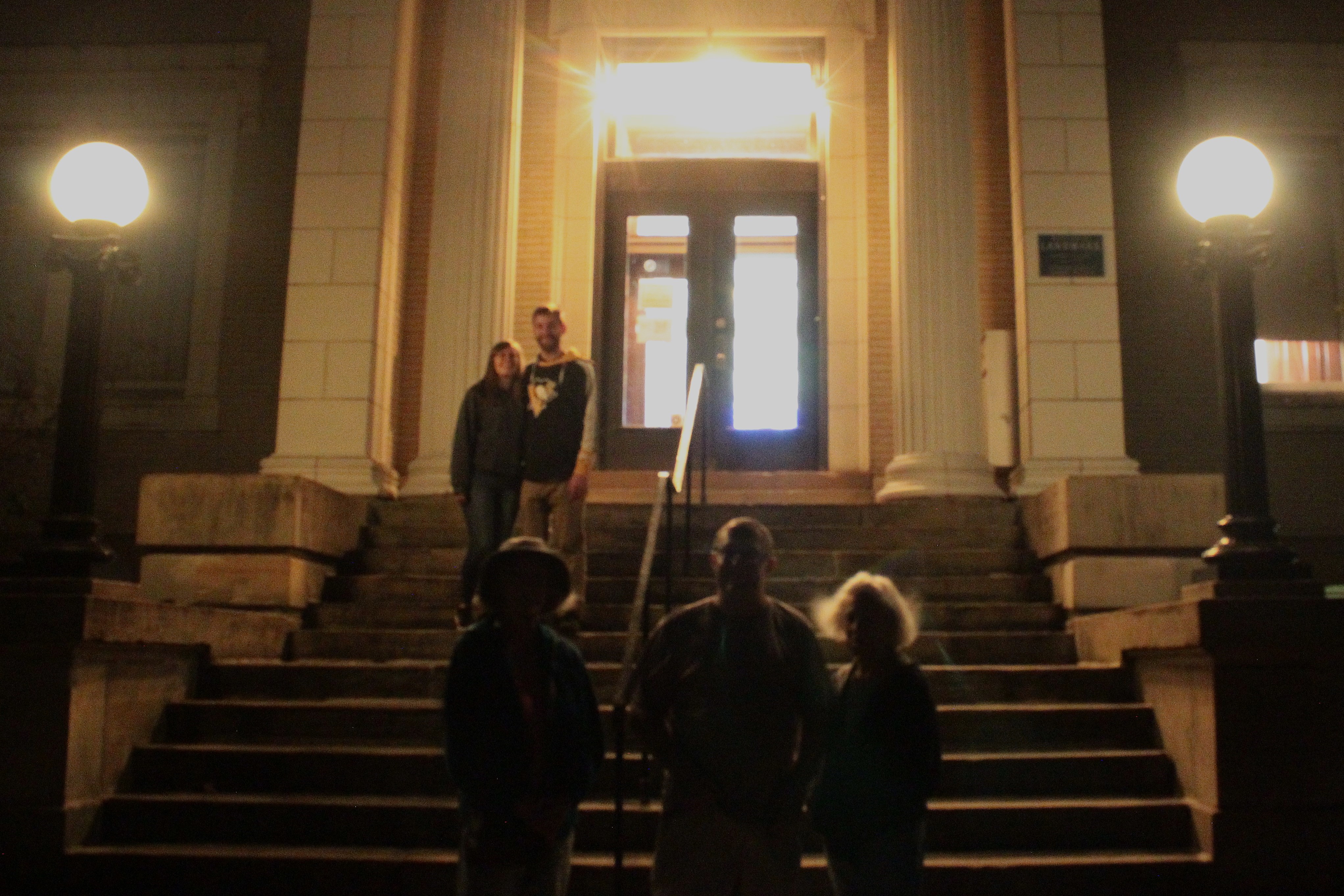
    I left the building without looking through either of the two telescopes that were being used. The clouds were making viewing difficult but most of the visitors saw Saturn and that is always something to remember! Even though I didn’t do any observing, as I headed home I had a feeling that in a small way I had participated in the history of this building and that I had been submerged into history itself. Old books, history and astronomy; what a wonderful combination!


Sunday, April 16, 2023

The Launch

 Pulling into the circular drive around the building, we were surprised to see only one other car. We were early but had envisioned many more cars and people.

    We parked near the front door of the Allegheny Observatory, got out and walked down the sloping lawn in front of the building. The trees were in bloom and the sky was a deep shade of blue with no clouds to be seen. It was quite a difference from the storms that passed through the area the night before.

    Ann Marie and I had come to watch the test launch of a balloon in preparation for next year’s solar eclipse. (Less than a year away!) NASA and the University of Pittsburgh are planning a couple balloon launches during the eclipse to study the thin wavering bands of shadows seen just before and after these events. 

    While talking with a neighborhood dog walker, I saw Lou Coban, the head man at the observatory, coming out from the back of the building, wheeling two large gas canisters. His team followed behind carrying more gear. (They had parked further back from where we were) 

    They pinned a tarp onto the grass and started unpacking their gear. The balloon was wrapped in a plastic bag. White cloves were donned before anything was unpacked, I’m guessing to help maintain as much sterility as possible. Checklists had been checked and still questions flew, making sure nothing was forgotten.

    This was their second test flight with a possible 8 more before the April 8, 2024 eclipse. They plan on launching their two balloons from a location in Texas.

    The payload has two cameras, one pointing up at the balloon and the other, a 360 degree camera looking down at the ground. There is also a tracking device to help them find it after it parachutes to the ground. They are guessing that the flight will last about an hour, barring any difficulties, before the balloon reaches 85000 feet and the payload is released or the balloon pops.

    The group will then mount a expedition to try and reclaim the payload. The observatories name and phone number are printed on the sides in case someone comes across it before they locate it. A past flight took the balloon over the Laurel Highlands.


    The balloon was filled, using a gauge, they tested its lifting capability as they proceeded, adding just a bit more than the payload weight.

“Don’t let go!!!”


    Once the balloon was filled, the bottom was sealed and the items going on the ride were attached, one below the other.

    Verbally they rechecked their lists and at 10:13 the cord holding it to the earth was released. The balloon, mimicking the shape of the near-by observatory quickly rose up, getting smaller and smaller to the people below.  The observers and crew took pictures and shaded their eyes, watching it as it disappeared.

    Then, the clean-up started. The tools were put back where they belonged, where they could be found for the next flight. This was when Ann Marie and I returned to the car. After enjoying the show, we were ready to search out a diner and get some breakfast!

    Later, in the afternoon, we found out that the balloon went to 95,288 feet before it ruptured. The release device didn’t work for some reason. The payload was found in the top of a tree which had to be cut down to retrieve it. This is why they do the test flights, to help eliminate these problems. Next time it will be an even better flight!


Monday, November 14, 2022

Ghosts of the Past

The November meeting of the Amateur Astronomers Association of Pittsburgh was held at the Allegheny Observatory, perched on a hill in Riverview Park. We haven’t had a meeting there in quite awhile. There were about 18 members that braved the downpours outside. The early darkness of Standard Time along with the pounding rain made the drive difficult. The other club members attended via the wonder of Zoom.

    The original observatory was built in 1859, on a hill overlooking Allegheny City, now Pittsburgh’s Northside.  

The present observatory was built in 1912 a few miles away. 

    This month’s meeting was devoted to the club's annual photography contest. It was extremely hard to pick your favorites out of the submitted shots. The members have a lot of skills, and the photo contest shows it!

    As the pictures were being shown, I noticed someone in the shadows, in the back of the auditorium, I thought I recognized him. It looked like Albert Einstein, could that be…maybe it was just one of the ghosts of the observatory!

    After the meeting, a few of us stayed behind and got a quick view of the new telescope in the Keeler Dome. Behind a locked door, we climbed a narrow set of stairs to another locked door which led us up a smaller set of stairs into the dome. The telescope towered above us as we climbed up the steps. A 24” PlaneWave telescope, it is the 4th scope to take residence in this dome.

    Since it was still raining outside, we didn’t get to see anything through the scope but we did get to see how quickly it can slew from one side of the sky to another! While looking at the telescope and the 100 year old dome it is under, I was reminded of all the ghosts that roamed these halls. John Brashear served as the Acting Director of The Allegheny Observatory when it was located closer to the city. He and his wife Phoebe’s ashes are interred beneath the Thaw Telescope at this location. The halls here have been walked by hundreds of famous and learned scientists and astronomers, I’m happy to say that I know a couple of them!

    The ghosts are also memories of times spent here. The time I viewed Saturn through one of the big scopes, club meetings that were held here and the Christmas/Holiday parties held in the basement. Being taken on tours and seeing the multi-storied library and wishing that someday I’d have one just like it. Seeing the offices and workrooms, the machine shop and of course, being able to see the telescopes and the equipment used to do the research, soaking in the history that exists in the building!

    John Brashear’s statue sits in the hallway, greeting visitors as they enter the building. Like many before me, I rubbed his foot for luck as I passed the statue. John Brashear is a man that the people of Pittsburgh looked up to, the same way as many of the members of the AAAP do!

    Before we left, we squeezed through a small wooden door and a narrow unfinished corridor and went out onto the roof of the observatory. The biggest dome of the three, the Thaw dome was in front of us. The rain had slowed down a bit and we went out and looked around and then hurried back inside.

    After that, I returned to the main floor, got my hat and jacket and went out to the car, leaving the history and the ghosts behind.


Adventure is Where You Find it!

The day was done. I had spent a fair amount of it working in the yard and as far as I was concerned, it was time to relax.      Sitting do...