Showing posts with label AAAP. Show all posts

Thursday, October 22, 2026

Looking into the Past

“9/26/90- Fog, everywhere but up”

    I have been searching through my slides and pictures for shots taken at the Wagman Observatory and of our club. The Amateur Astronomers Association of Pittsburgh (AAAP) is rapidly closing in on its 100th anniversary. Hopefully, the pictures I find can add to the club's history. Their observatories, the members, star parties and events they held are all included in my search.

    As I am doing this, I am also winnowing down my collection. Do I really need 10 shots of a partial lunar eclipse taken 15 years ago? Are the slides filled with dots of mold really worth saving? Let me tell you, the wastepaper basket has been getting a lot of use lately!

    While searching I have also come across a lot of pictures that I want to save. I have also come across many that cause me to wonder.

    I found some pictures of the desk in the Wagman Observatory, taken before the addition had been added. One was just the desk and the others were of me, writing in my journal. The colors were red and black. I attempted to enlarge the picture to see what I was writing or what was on the sky atlas open beside the notebook. The pictures weren’t sharp enough to see any details.

    I continued copying slides but my mind kept returning to those pictures.

It wasn’t until later in the evening that an idea hit me. The date was noted on the slides! I could look in my journals and see what I had written. This unfortunately would involve another trip up to the attic. This isn’t the easiest thing to do these days.

    A day or two later, I made the trip. I went through the cubbyhole in the closet and up a sketchy set of rungs into the space under the rafters. I knew exactly where they were kept, in the bottom drawer of a file cabinet. I pulled out the one I needed and then after a moment’s thought, grabbed the entire pile and brought them downstairs with me.

    Looking through them, I found the journal I was looking for and turned to the date in question. There it was! The page in the pictures! Reading the entry, I found out that the evening was foggy. The sky overhead was clear, but it was rapidly disappearing. I had taken some photos of Mars and the Andromeda Galaxy. I had also dropped my camera, breaking a filter and a shutter cable in the process. (8:21PM if you’re interested)

    After closing the roof because of the approaching fog, I took a couple pictures of the desk to check whether the camera was still working. This was a film camera, no digital stuff yet.

    This wasn’t the first time I ever dropped a camera, believe me. I get a chill just thinking about it. Hopefully this occurrence helped me become even more careful with my gear!

    I find it fascinating to leaf through these notebooks. There are times when I can remember the exact day and event listed in them; all it takes is a simple sentence. Of course, there are so many things written down that I have completely forgotten. (Such as the time my car battery died after a Christmas Party at Alleghany Observatory) I enjoy looking at the simple sketches I made and am sometimes amazed at the detail in some of them. The items stuck between the pages are another exciting thing to look at: pictures, newsletters, notes and lists.

    Looking at my journals, I see that the collection isn’t complete. There are more than a few missing. I guess I’ll have to make another trip up to the attic.

    Whether or not these journals will ever be anything other than a reminder of the past is yet to be seen. I definitely am glad that I kept them. They are filled with memories of not only stellar observations but memories of family, friends and good times I’ve had under the stars. They also remind me of some of the mistakes I’ve made, such as dropping cameras. Oh yeah, I need to remember those also, no matter how foolish they were.


Thursday, October 8, 2026

Not Your Typical Morning!

 It was tough getting to sleep. The anticipation was heavy on my mind. After rolling around a bit, tossing and turning, I got up and got dressed. I loaded my telescope and gear into the car and headed up to the Wagman Observatory.

    Arriving on the hilltop at 1, I found two other club members (Amateur Astronomers Association of Pittsburgh) in the field with their equipment, taking pictures of the sky. I opened the building and pointed the 11” Brashear telescope at Saturn. I invited the men in to take a look. We introduced ourselves and BS’d a bit while we enjoyed looking at the ringed planet. As always, it looked great!

    I had come up to watch the occultation of Jupiter by the moon. These events only happen every 13 years, give or take. The conditions were looking good this morning, the sky was clear and crisp, and the moon/Jupiter pair would be in a good position to observe them. Unfortunately, the event would be hidden from the Brashear telescope by the building, so I closed up and went outside to set up my gear.

 The camera came first. I took some pictures of the moon rising behind some trees on the horizon. Jupiter followed close behind.

    Setting up my telescope came next. Another club member, John Holtz, showed up and started setting up his scope. I had imagined that more members would be here but I guess that since it was a Tuesday morning, work may have played a part in it.

    By eye we could see the bright planet getting closer and closer to the bright arc of the moon. The moon was only 20% illuminated and paired with Jupiter, they looked like a poster!

    Through my telescope I could see the entire moon. The majority of it was a dark semi-featureless disc against the sky. The lit portion beautifully showed craters and mountains. Moving in on it was Jupiter. The planet's cloud bands could be seen. In front of the planet, closest to the moon were three of the Jovian moons and behind the planet, another one. This all could be seen through the eyepiece. It was overwhelming!

    The first moon in line, Europa disappeared into the bright arc and about a half minute later, Callisto disappeared. I lost sight of Io, the third moon in line and never saw it touch the lunar disc. Then came Jupiter! It took a minute for it to completely disappear. (4:20:56am by my clock) Finally, bringing up the backend was Ganymede.

    John and I compared notes and shared our thoughts while we waited for what we imagined would be the best part of the show.

    Just over an hour after Europa disappeared, it came back into sight.

    In my eyepiece I was looking at the dark section of the moon. It showed up nicely compared to the sky beyond. The bright section was hidden from view. I had an idea of where the moon would reappear but wasn’t sure exactly. I scanned back and forth. Then, suddenly there it was. There was no mistaking it; it looked as if a light had been turned on!

    Spectacular!

    Two minutes later Callisto appeared and less than a minute later, Io joined the train, slowly drifting away from the moon.

    Then the real showstopper came, Jupiter. It took a minute and six seconds to fully appear. (5:23:05am) It looked unbelievable; the cloud bands crossing its surface looked great against the dark arc of the moon. About a minute and a half later, Ganymede joined the parade. 

    I just stood there and watched as the moon slowly distanced itself from the Jovian grouping.

    Then it was time to break things down. We watched as the Chinese space station, Tiangong crossed the sky overhead. We saw a bunch of satellites and a couple meteors as the morning progressed.

    The morning was more than I had hoped it to be. Seeing the advancing moon covering over these bright objects was wonderful, but the reappearances on the dark side were the best. Watching Jupiter and its moons come out from behind the darkened side of the moon was not only extremely easy to see, it was also extremely memorable. It was like a science fiction movie but it was real life! Motion in space! I will remember this for the rest of my life! (I hope)

    What a great morning. Science and astronomy rocks!


Sunday, August 3, 2025

The Shadow Transit of Titan

I spent the early morning hours of Sunday watching an event along with three other members of the Amateur Astronomers Association of Pittsburgh. (3AP.org) Using the 115 year old, 11” Brashear Telescope at the Wagman Observatory, John Holtz, Mike Miller, Sean Matoon and I watched as the shadow of Titan, one of Saturn’s moons, crossed onto and across the planet’s surface. These transits occur about every 15 years.

    The astronomy club had two star parties this weekend and after the second one, after the public had departed, we aimed the telescope at Saturn. The seeing was pretty steady, the image wasn’t bouncing around at all and we had no problems increasing the magnification.

    Neptune was sitting within a degree or two of Saturn so we swung the scope over to it while we were waiting for the transit to start. The planet first appeared as a faint blue dot but by increasing the magnification we were able to see it as a round disc. We weren’t able to see any features on it. The shadow of Titan would be about 1/3 the size of Neptune, this could be difficult!

    As Saturn orbits the sun, our view of the planet's rings change. We recently passed through the ring’s plane where the rings appear to us as being edge on. This gives us a quite different view of the planet as to what we are familiar with.

Notesfrom a Reading Addict: Going, Going...

    When the planet is in this orientation, the shadow of Titan, the largest of the planet’s moons, can be observed crossing the planet’s surface. The moon orbits Saturn every 16 days so we have a chance to see this event a couple more times during the next month or two.

    Moving the scope back to Saturn and turning off all the lights in the room, we watched. Titan could be seen sitting below the planet’s rings on the right-hand side. The transit was due to start at 2:25 but we couldn’t see it until 2:30 when John first located it.

    Over the next hour and a half, we watched as the shadow slowly worked it’s way towards the meridian. We experimented with a variety of eyepieces, giving us magnifications between 243 - 939 power! While the viewing at 939X was nice, as would be expected, we opted for a lower power which gave us a much crisper image. We even tried using a binocular viewer which sadly, was difficult to use. It did give me a nice 3-D image of the planet!

    The shadow was dim and I had difficulty seeing it. The other three having much better eyesight could see the shadow much easier.

    We watched it, taking turns at the scope until a bit after 4 when we decided to close things up. Dawn wasn’t far away, our homes seemed even further. I pulled up in front of my house at 5.

    I think it was great seeing this. It is another astronomical event to tuck into my belt. It wasn’t quite as exciting as watching a solar eclipse or watching Mars slip behind the moon but it was right up there with them!


Wednesday, September 11, 2024

Going, Going...

    Saturn is known for its rings. They are visible even in a small telescope. I never miss the opportunity to view this planet; it is definitely my favorite, with Jupiter coming in a close second.

    Six months from now, the “Ringed” planet Saturn will become just plain old Saturn. Due to its orbit around the sun it will appear to us here on Earth, as having no rings!

    If you get a chance to take a look at the planet in the next couple months, by all means do it. The rings are bright, but they don’t look like rings right now. They are in the process of disappearing and appear more like a line drawn across the planet. As the planet slowly tips, the rings will be seen edge on and will appear to vanish. Like looking at a piece of paper edge on, it is very difficult to see.

    This won’t be forever; gradually they will get thinner and thinner until only larger telescopes will be able to see them. Then they will slowly start to reveal themselves again.

    This isn’t the first time this has happened, it last happened in March of 2009. In 1995 it happened twice with a third disappearance happening at the beginning of 1996. I dug out my notes from 1995 and on June 17th, 1995, using a very good telescope, I had trouble seeing the rings without using averted vision. The next disappearance will occur in October of 2023.

    Right now, Saturn lies “about” 805 million miles away from us and its rings are only around a mile thick. This distance makes them extremely difficult to see edge on. In case you are wondering, presently it takes the light from the sun about an hour and 12 minutes to reach us after bouncing off Saturn’s disc. Another interesting fact is that Saturn takes 29.4 years to make an orbit around the sun! 

    On Saturday, September 14th, the Amateur Astronomers Association of Pittsburgh will be holding another star party at the Wagman Observatory in Deer Lakes Park! This will be a great time to take a look at the rings through one of the scopes that will be set up there. The planet Saturn will definitely be the focus of the night, along with the moon and other celestial objects. Bring your own scope if you have one, if you’re not sure how to use it, we will be happy to help you out! Come up to the hilltop and take a look at Saturn’s rings, before their gone.

For more info about the AAAP Star Parties, go to

3AP.org


Sunday, May 12, 2024

Viewing the Aurora from Wagman

 Chances are that you have heard numerous reports, seen hundreds of photographs and even listened to and watched news reports about Friday night’s auroras. Well, let me add one more to your pile.

    The sun is currently at what is called solar maximum, the peak of an eleven year cycle. A massive coronal mass ejection from the sun was due to hit the earth causing a huge geomagnetic storm. The particles expelled from the sun interact with the earth’s magnetic fields and causes what is known as Aurora Borealis or the Northern Lights. (In the southern hemisphere, they are called Aurora Australis or the Southern Lights.) Solar observers gave notice a few days ago and rapidly the word spread. Astronomers passed the word via the internet and before long TV newscasters were mentioned it along with how and where the aurora could be viewed.

    The convergence of any astronomical event and bad weather is a well known coincidence. In astronomy clubs a common joke is that by simply buying a new telescope or eye piece you will be bringing bad weather into your hometown. Astronomical events such as conjunctions, occultations and eclipses can bring on this phenomenon also. It was because of this that I reigned in my enthusiasm a bit!

    The Amateur Astronomers Association of Pittsburgh (AAAP) had its monthly meeting on Friday night. Attendance was in person or via Zoom, I chose to attend by way of my computer. Sitting beside the window my attention drifted between the meeting, the NOAA Aurora Prediction page (it was looking good!) and the sky outside. I left when the meeting was half over; the chance that something might occur in the sky overrode the meeting’s presentation.

    The clouds in the sky were very dramatic looking, tinged with oranges and reds. I was hoping that the sky would clear as I drove towards the club’s observatory. As the sky darkened there seemed to be a brighter patch in the north and while I didn’t think it was an aurora, the thought did cross my mind more than once. My hopes were rising.

    Pulling up to the gate at the Wagman Observatory, I found that the small parking lot was filled and cars were parked alongside the narrow road. Someone had parked directly in front of the gates and I had to search them out in able to open them.  There were about 20 or more people scattered across the field. Once the gate was opened cars flooded into the field, coming and going for the rest of the evening.

    At 9 o’clock the sky was still rather bright. The crescent moon in the west was all that was visible. Slowly more and more stars appeared. A large cloud was situated in the north but still everyone there was hopeful and excited. People stood alone and in groups, all facing the north. A TV camera man had his camera set up, patiently waiting along with the rest of us. Cameras were set up on tripods and nearly everyone had phones in their hands, quietly talking among themselves. During the evening, at least 10 members of the AAAP arrived along with a crowd possibly numbering 100 or more.

    The first noticeable burst came right after 10. I heard someone say “I can see it!” and then, there was no doubt that we were seeing an aurora. A big one!

    Batches of colors, mainly red and pink (to my aging eyes) appeared in the sky. Fainter colors appeared, looking more like rays or curtains. They would appear and then fade off only to reappear elsewhere, different shapes and colors. Grays and whites along with yellows seemed more prominent behind the observatory while the blobs or larger batches of colors seemed to be mostly off to the left, in the NW. The aurora grew in size, eventually extending past the zenith and into the southern skies. It was spectacular!


    About 15 minutes into this show, the International Space Station made a pass almost directly overhead. Its pass made it appear to slice through both the Big Dipper and the aurora. We couldn’t have asked for more. Everyone in the field was excited.


    It was fun being in a group while experiencing this event. The feelings of happiness and wonder were contagious. I couldn’t help but compare it to last month’s total solar eclipse, both events showcased the wonders of our world and the beauty of the skies, presents that were given to us to enjoy.

    The show continued for about an hour before fading down after 11. The TV man provided footage for the Channel 2 news.  Thousands of pictures were taken. The glow of smart phones was seen everywhere I looked. The pictures taken by them were dramatic, providing more colors than what we saw by eye. I was envious; my camera exposures were in the 20-25 second range while theirs were just a second or two, but I still enjoyed the process of photographing the aurora. It’s interesting how different cameras and phones produced different colors in their pictures.

    The club members started packing up to go a bit after 11 and I was getting tired also. Before we could leave we had to get all of the cars out of the field. Thankfully there were only 6 or 7 left. We told the owners that they could stay on the hilltop; they just couldn’t leave their cars there. There was one driver we couldn’t locate, after a brief search, I finally found him over the hillside below the observatory.

    While locking the gate, a County Policeman arrived with lights flashing. There were cars lining both sides of the road, some had actually parked on the road rather than off to the side. I can only imagine that some tickets were issued after I left. People were still arriving as I drove away.

   The last time I had seen an aurora, the only other time I might add, was at the same place, Wagman Observatory, on June 13th, 1991.

     I drove home through a thick fog and when I got home, nothing was visible in the sky at all. I was extremely happy to have taken the drive up to the observatory!

    During the event, I couldn’t help but think; last month we had a total solar eclipse and this month we were treated to a fantastic aurora. What in the world will June bring us?


Tuesday, April 16, 2024

And Then The Sky Turned Dark!

 The solar eclipse of 2024, “The Great American Eclipse” was something that I had been looking forward to for years, if not decades. Seeing that it would pass so close to my home, I knew I had to see it.

    As the years passed by, it wasn’t constantly on my mind but yet, it never was far from it, especially in the past couple years. Astronomy magazines were writing stories about it and as the event came closer, the news stations started picking up on it. Local city governments started warning about the possible influx of people and motels and hotels started raising their rates. Eclipse mania was rising.

(Locations of various AAAP members during the eclipse)

    Ann Marie's brother and sister-in-law have a farm in Indiana, only a few miles away from the centerline of the eclipse. The decision was made to observe from there, they were gracious enough to welcome us to their home. Our "reservations" were made well over a year before.

    I tried my best not to worry about the weather because that was the biggest deal-breaker. If the clouds moved in or it was raining, there was nothing we could do but except it. While we were driving west across Ohio, we drove through rain and the skies were cloudy. Occasional patches of sunlight raised my hopes. We drove over on a Friday, four days before the big event.

    There was a definite police presence on the highways. Signs warned about the upcoming event and suggested staying late after the eclipse to avoid traffic jams. Entering Indiana, we saw t-shirt stands with eclipse shirts for sale along with ads for various eclipse events. 

    Saturday was beautiful, clear skies and warm temperatures. I caught the thin moon rising in the morning. A couple geocaching trips were made during the day. That evening I set up my telescope and we had an impromptu star party. Jupiter and its moons hung on the edge of the western horizon with Orion close behind. The Beehive Cluster was easily seen by eye. 

    It was a late night, the dark skies overhead had plenty of things to visit!

    Sunday morning, the day before the eclipse, I attempted to see the thin crescent moon, but was unsuccessful. The brightness of the morning and the thinness of the moon thwarted me. The next day the moon would be new, and nearly touching the sun as they rose, I’d have to wait until the afternoon to see the moon, during the eclipse!

    The weather was less than desirable. We went hunting for morels and saw a double rainbow in the afternoon. The rainbows were a foretelling of what was to come!

    Monday morning was clear with only a small bit of fog, off in the distance, over top of the river. I still didn’t want to get my hopes up. Some friends of the family flew in (using their own planes) to view the eclipse with us. We ended up with eleven of us at the farm, sitting outside the house, patiently waiting as the moon slowly drifted in front of the sun.


    We did an experiment with a colander, allowing the sunlight to shine onto a paper plate held below it. All the bright spots reflected the image of the partially eclipsed sun, even the rectangular spots!

    The temperature dropped enough for us to notice it and the sky took on a darker appearance as the moon worked its way across the suns disc. A couple people said how it looked as if a storm was coming and how they felt a bit disorientated. The colors of the patio furniture got more intense, and the shadow of my pen seemed sharper as I scribbled notes. We could see the moon's shadow before it hit us, it moved towards us at a tremendous speed. 

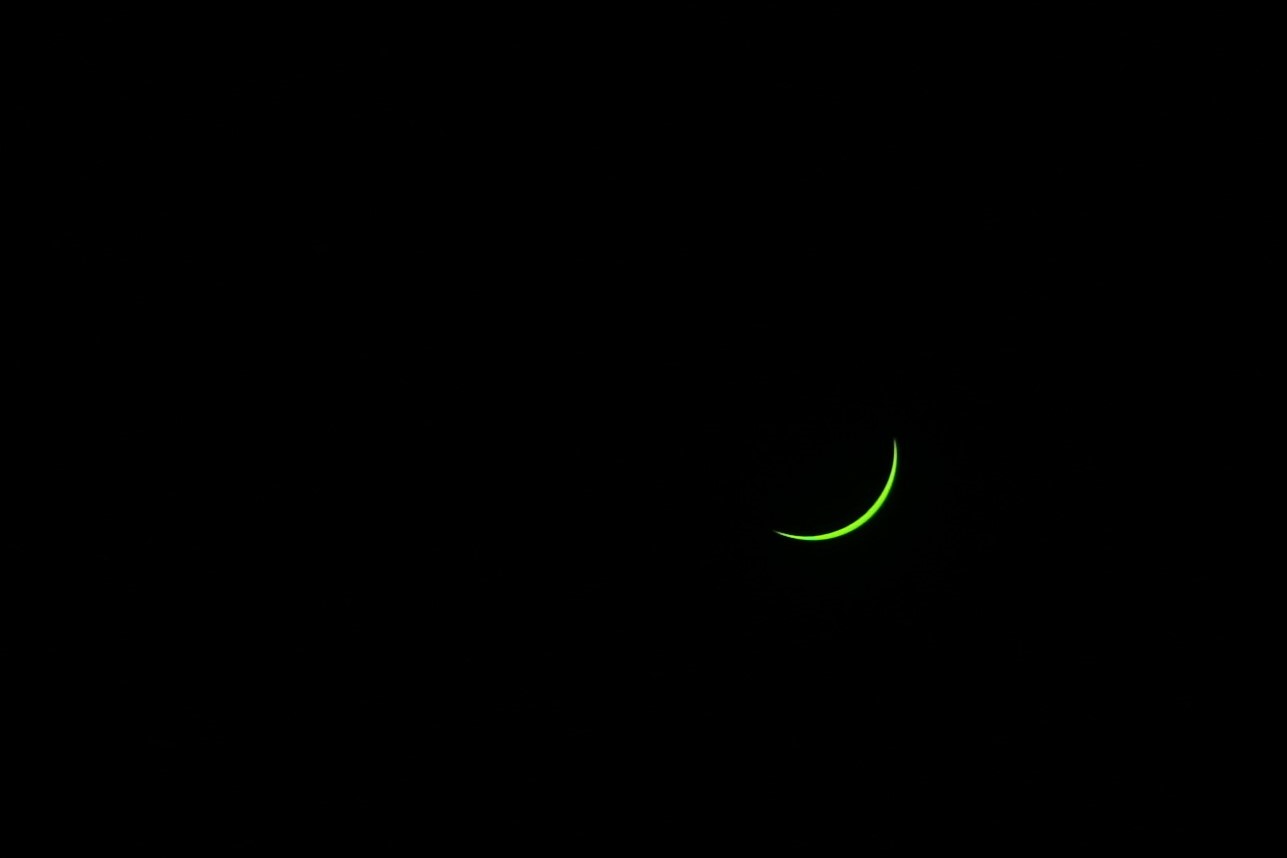
    And then the sky turned dark! Real dark, night-time dark. Looking up, the first thing I noticed was Jupiter and Venus sitting on either side of the pair. The area surrounding the sun was brilliant white with spikes. Using binoculars, I could see a bright pink dot on the lower portion of the moon. It was a prominence, a flare coming off of the sun. The pink color was caused by the hydrogen that was burning in it. Others around me saw it also, confirming my skeptic observation.

Totality, taken by Sarah Balzer

I felt emotions rushing through me. I seriously felt as if I might cry. I didn’t know whether to jump up and down or to laugh, yell or scream. I think I might have done a bit of all of them.

We had just over 4 minutes of totality and it proved to me that time is not constant. It was over before we realized it; time had sped up during this experience, no doubt about it!

    While the moon slowly continued past the sun we all started talking and comparing our experiences. Phones were used to check pictures and to contact others to see what they thought about the eclipse. In the yard, the bees were returning to their hives.

    It was nice sharing the experience with others! We all became a community together, people from all over coming together to experience this show that our universe was putting on for us! The word camraderie popped into my head.

    Later that evening, after the sun (and moon) had set, I set up the telescope again and we had another nice dark evening of star gazing. We packed our gear the next morning and after another wonderful meal, Ann Marie and I returned back to the Pittsburgh area. Coming back we heard more eclipse tales on the radio. We had no problems with traffic but we did see a lot of policemen, same as when we were coming out.

    We made it home a bit before sunset and I didn’t even check to see what the sky was like, I had a bed waiting for me! The trip was a life event, something I doubt if I’ll ever see again. I waited a long time to see this and believe me, I wasn’t disappointed!


Monday, July 24, 2023

Good Nights For Sharing Stars


The past weekend, the weather gods were smiling on us. The Amateur Astronomers Association of Pittsburgh (AAAP) was able to hold four successful star parties, two at each of our observatories, Wagman and Mingo Creek. A few clouds drifted by, but the festivities went on, nevertheless.

    We had a thin sliver of a moon to look at on both nights. Since the moon was visible before the sun set, it was the first major attraction for the member's scopes. A couple members had solar filters and were able to show early visitors views of the sun's surface. At the present time the sun has lots of sunspots on it, making it an interesting view.

    The planet Venus was our next target. The planet Mercury was off to its right, a binocular view if you looked carefully. Since the planets were close to the horizon, we only had a short time to observe them before they dropped down into the trees.

    Mars was observed for a short while but we moved back to the moon since there was so much more to see on it.  As the sky darkened, we moved on to other objects such as Albereo in the constellation Cygnus and the double stars, Mizar and Alcor in the handle of the Big Dipper. A few Messier objects were shown and we watched a couple low passes of the International Space Station. A few guests were lucky enough to see some falling stars though we had nothing to do with that!

      We had a group of veterans visit along with families, students and daters. (I can only assume they were dating…) Everyone seemed happy to be there, some even coming over before they left to thank us for sharing the skies with them.


    My favorite moment was when a small girl took a look at the moon and told her Grampa, “WOW, look at all those craters!” I didn’t have to ask if she had seen it, we all knew it!

    At the Wagman Observatory, the crowds started thinning out after 11. A few waited long enough to see the ringed planet, Saturn, through the Manka reflector. In the Brashear room, we had to wait until the planet rose over the roofline before we could observe it.

    Let me tell you, as always, Saturn is worth the wait! The 11” refractor gave a nice, steady view of the planet along with 3 or 4 of it's moons. The rings are moving towards an “edge on” view, they aren’t as wide open as they were a few months ago but it is still spectacular!

    This is one of the fascinating things about astronomy, watching how the planets (and Moon) change. Saturn’s rings are moving towards a point where we won’t be able to see them.  Venus has phases that it goes through, just like our moon does. Both are currently thin crescents. Soon Jupiter will be visible again in the late evening skies along with it’s four brightest moons. It is always enjoyable to watch as the positions of these moons change over the course of an evening.

    Church was early the next morning, so after spending 15-20 minutes with Saturn, I closed up the Brashear room. A couple members were still out in the field, planning on spending the rest of the night. (I should say morning since it was after midnight.) I went home and crawled into bed for a couple hours before I had to get up again. I definitely had something to be thankful for in the morning. A couple more nights of good observing added onto all the other great things we have in life!

    Next star parties are in August…see ya there?


Friday, April 28, 2023

Leo J. Scanlon

 The e-mail has just arrived. Tonight’s star party has been cancelled due to rain, clouds and muddy fields. I had an idea that this was going to happen. There is a good chance that tomorrow’s activities at the Wagman Observatory will be cancelled also. They tend to go hand in hand, plans for anything astronomical and bad weather.

    Even though it is doubtful, I am still keeping my fingers crossed for Saturday night. We can’t give up hoping!

    Along with Independent Bookstore Day, which won’t be hampered by rain, tomorrow is also Astronomy Day. This is a day when astronomers, both amateur and professional, share their knowledge, enthusiasm and love of the skies above us.

    This year’s Astronomy Day comes at a good time, it is the day before the birthday of a man who spent his life promoting astronomy. On April 30, 1903, Leo J. Scanlon joined the human race. 

    In his 20’s, he built his first telescope and not long after, he and Chester Roe formed the Amateur Astronomers Association of Pittsburgh. (AAAP) The club is still thriving. He was a plumber by trade but his real love was the stars above!

    Shortly afterward, he and friends, no doubt club members, designed and built the Valley View Observatory.

Leo sitting on the dome to prove its strength

Placing the dome

Almost ready for use

    Located in his backyard in the North Hills of Pittsburgh, it was the first observatory to have an aluminum domed roof on it. His design was copied by numerous professional observatories and gave us the image we picture when we think about observatories. It was dedicated in November of 1930 and stood there until 1997, 67 years later, when it was dismantled.

Leo and Albert Einstein

    In 1934, he sent a letter to Albert Einstein inviting him to visit the AAAP display at the convention of the American Association for the Advancement of Science which was being held in Pittsburgh. When Einstein arrived, he spent about 20 minutes at the display and later corresponded with Leo.

    During the same year, he was invited to watch the pouring of the glass which would form the 200” mirror for the Hale Telescope at the Corning Glass Works.

    Leo was influential in getting the city to build the Buhl Planetarium. After it was built, he and Nicholas Wagman, the director of the Allegheny Observatory were the first two speakers to give lectures at the facility.

    He also had a part in helping to create the Astronomical League in 1947.

    In 1998, a historical marker was placed on McKnight Road, not far from where his observatory sat. During the ceremony, he was told that an asteroid had been named after him!

Leo at First Light of the Brashear Telescope at Wagman, 1995

    Leo passed away in 1999. He led quite an exciting astronomical life for a plumber. He is another person who set an example for us, of what a person can accomplish.

    While we watch the rain falling outside our windows, let's give a little thought to the people like Leo and think about how we can follow in their footsteps!

    Happy Birthday Leo, thanks for all you’ve done for us!


Sunday, March 19, 2023

Star Party Season is Almost Here!


If you are at all like me, you remember the two bright objects, very close to each other, in the western skies a few weeks ago. They weren’t stars, they were planets. The brighter one of the two was Venus and the fainter one, Jupiter. Since then, Jupiter is neared the horizon in the evening skies while Venus still stands strong in the twilight.

    Did you know that the planet Uranus will be close to the bright planet Venus towards the end of the month? You can see the pair from your backyard, use binoculars to see the fainter Uranus, OR, you can come up to the Wagman Observatory and see them there.

    The Amateur Astronomers Association of Pittsburgh will be holding star parties on the last day of March, (the 31st) and the first of April. (no joke!) Being held at the Wagman Observatory in Deer Lakes Park, the club members will show you these objects and many others during the nights. Star parties are held in the warmer (?) months of the year. The March/April parties will be the start of the 2023 Star Party Season.

    The club holds these events to allow the general public to come and look through the telescopes belonging to the club and its members. There are two permanently mounted scopes at the observatory, an 11” refractor built by the prominent Pittsburgh optician John Brashear (above) and a 21” reflector. The mirror for the reflector was made by the same company that John Brashear founded over a century ago. (We are a very Pittsburgh oriented club!)

    There is no charge for these parties; they are open to anyone who wants to see more of the sky above them. Bring the family, please! The observatory is in a darker portion of the county and almost everyone will see many more stars than at home in their light polluted neighborhoods.

    Are you thinking about getting a telescope and aren’t sure how to go about doing it, not sure what kind or what size to get? There are lots of options available. At a star party there are always a variety of scopes, different styles and sizes, you can browse among them and see how the views differ and ask the owners what their opinions are.

    Have you recently gotten a telescope and aren’t sure how to set it up or how to use it? Bring it with you and chances are someone will be there that can give you a hand or some advice. Ask at the desk to see if someone can help you. Just setting up a scope will bring club members over to see what you have! You can also join the club if you're interested!

    The kids enjoy being able to look through the scopes and seeing planets they’ve read and learned about. There are a couple programs available for the kids to participate in. Those between 2nd and 6th grades can work on the Passport to the Universe Program. They are given a passport and the idea is to find the various astronomical things listed in it. After finding them, they are awarded a certificate and a book. For the older kids there is the Junior Messier Program. After finding some things a little bit harder, they also can get an award and a certificate. Club members are happy to help them find the objects they are searching for.

    Weather permitting, (a big condition here in Pittsburgh) during these star parties, we will be able to see Jupiter and Mercury, very close to the western horizon. They will be setting soon after sunset. Higher in the sky will be Venus and beside it, the planet Uranus. Since Uranus is so much dimmer than the brilliant Venus, you’ll probably need some binoculars or a telescope to see it. Club members will direct you to it, it won’t be hard to find, especially when you have a bright planet to lead you to it!

    Chances are, the moon will be the first thing the telescopes will be pointing towards, since you can easily see it while the sky is still bright. As the sky darkens, Venus and Uranus will come under scrutiny by the observers. Then things such as Mars, Orion and it’s nebula, star clusters, galaxies and double stars. If we are lucky, we will see a pass or two of the International Space Station or maybe the Chinese space station, Tiangong. There is also the possibility of seeing a couple “falling stars”. You never know what you might see at a star party till you get there and see for yourself. That’s part of the fun of them, what new things will I see tonight?

    Bring your binoculars; you’ll be amazed at how much you can see with them! Leave your flashlights at home, the moon will be providing more than enough light to see. Bright lights are frowned upon because the darker the area is, the easier it is to see the fainter objects and to see more details. So being, please, turn off your car headlights as you enter the grounds.

    For more information about star parties or the A.A.A.P., click here, 3AP.Org. Directions to the clubs two observatories can be found there along with the dates of future star parties. If the weather looks doubtful, call the observatory (724- 224-2510) to see if the party is still on. Inclement weather, clouds, rain or snow will be cause to cancel the event.

    It is a great way to spend a Friday or Saturday night, after a hard week of work, relaxing under the stars in the fresh air. Best thing of all…it’s free!

    If you come, look me up. Hope to see ya there!


Monday, November 14, 2022

Ghosts of the Past

The November meeting of the Amateur Astronomers Association of Pittsburgh was held at the Allegheny Observatory, perched on a hill in Riverview Park. We haven’t had a meeting there in quite awhile. There were about 18 members that braved the downpours outside. The early darkness of Standard Time along with the pounding rain made the drive difficult. The other club members attended via the wonder of Zoom.

    The original observatory was built in 1859, on a hill overlooking Allegheny City, now Pittsburgh’s Northside.  

The present observatory was built in 1912 a few miles away. 

    This month’s meeting was devoted to the club's annual photography contest. It was extremely hard to pick your favorites out of the submitted shots. The members have a lot of skills, and the photo contest shows it!

    As the pictures were being shown, I noticed someone in the shadows, in the back of the auditorium, I thought I recognized him. It looked like Albert Einstein, could that be…maybe it was just one of the ghosts of the observatory!

    After the meeting, a few of us stayed behind and got a quick view of the new telescope in the Keeler Dome. Behind a locked door, we climbed a narrow set of stairs to another locked door which led us up a smaller set of stairs into the dome. The telescope towered above us as we climbed up the steps. A 24” PlaneWave telescope, it is the 4th scope to take residence in this dome.

    Since it was still raining outside, we didn’t get to see anything through the scope but we did get to see how quickly it can slew from one side of the sky to another! While looking at the telescope and the 100 year old dome it is under, I was reminded of all the ghosts that roamed these halls. John Brashear served as the Acting Director of The Allegheny Observatory when it was located closer to the city. He and his wife Phoebe’s ashes are interred beneath the Thaw Telescope at this location. The halls here have been walked by hundreds of famous and learned scientists and astronomers, I’m happy to say that I know a couple of them!

    The ghosts are also memories of times spent here. The time I viewed Saturn through one of the big scopes, club meetings that were held here and the Christmas/Holiday parties held in the basement. Being taken on tours and seeing the multi-storied library and wishing that someday I’d have one just like it. Seeing the offices and workrooms, the machine shop and of course, being able to see the telescopes and the equipment used to do the research, soaking in the history that exists in the building!

    John Brashear’s statue sits in the hallway, greeting visitors as they enter the building. Like many before me, I rubbed his foot for luck as I passed the statue. John Brashear is a man that the people of Pittsburgh looked up to, the same way as many of the members of the AAAP do!

    Before we left, we squeezed through a small wooden door and a narrow unfinished corridor and went out onto the roof of the observatory. The biggest dome of the three, the Thaw dome was in front of us. The rain had slowed down a bit and we went out and looked around and then hurried back inside.

    After that, I returned to the main floor, got my hat and jacket and went out to the car, leaving the history and the ghosts behind.


Looking into the Past

“9/26/90- Fog, everywhere but up”      I have been searching through my slides and pictures for shots taken at the Wagman Observatory and ...