Showing posts with label history. Show all posts

Sunday, June 1, 2025

Alleys

When going through towns many people tend to ignore the backsides of the buildings and stick mostly to the main streets, while I often find myself slipping back into the alleys behind.

    The main street through most towns and villages shows the best side of the community. The stores are painted nicely, the sidewalks are clean and there usually isn’t much litter along the curbs. The streets are well lit. The views are beckoning you in, inviting you to stop and stay for a while.


    This isn’t always the case for the alleys. Collections of trash cans and dumpsters intrude into narrow roadways. Unwanted furniture and electronics sit beside the cans with scraps of paper and bits of food scattered around. Occasionally the smells of the alleys can get a bit overwhelming. Rodents can sometimes be seen but most often they hide from us, the intruders.


    The road surfaces are filled with potholes, asphalt is broken and missing in places, bricks or cobblestone can be seen under the blacktop, evidence of the town’s past. So much of the alleys are reminders of the past. Loading docks and heavy doors line the alley along with stairways leading up to the floors above or to apartments and offices higher up. In older industrial areas, cranes hang out over the roadway to help in loading or unloading trucks. Ghost signs sit fading away on the walls.


    These back roads are often used as galleries for artist wannabes. Occasionally there are masterpieces hidden in the graffiti, artwork painted on the walls that few ever see. Sometimes they share the walls with ghost signs, they are both remnants of someone or something that was here before. Sadly, I feel that most of the graffiti is from people who have a desire to be remembered. Don't we all? It is amazing the efforts they must take to put some of these pieces onto the buildings.

    What was once the main road through town may have become one of these alleys. Now they are no longer seen since the town has expanded. Streams or rivers can be hiding behind the buildings on main street. Railroad tracks that once fed the businesses can be rusting away beside these dark streets, while in other places, trains speed past, no longer even slowing down.

    Alleys are like regular streets but they can also show the darker side of a town or city. There are some people who desire to stay out of sight, unnoticed, and prefer the less traveled roads. People with poor morals or bad intentions may decide to call these places their own. The chance for crime rises as we leave people’s sight and enter into the darkness. Common sense is important when visiting these or any unfamiliar site.

    Like the main streets, the alleyways of a town can show visitors a lot about the community. They aren’t always pretty and inviting but, in some ways, that is exactly what adds to the appeal of visiting them.

    We all have alleys of our own, hidden behind the façade we show to our friends, family and even ourselves. Our minds are filled with alleyways. Don’t be afraid to visit those alleys and if needed, do some cleaning. There are times that it can take some effort to brighten them up but it’s always worthwhile. Let the good and artistic things stay but clean up the garbage. We all know that once you allow trash to remain un-cleaned, the vermin moves in and none of us want that!


Thursday, July 4, 2024

Stepping Back in History

Back in the 17th and 18th centuries one of our ancestors' needs was for good quality tools and to get these, they needed metal. The Pennsylvania hillsides have numerous fields of iron ore and to turn this ore into metal they built furnaces. By putting the ore into a furnace along with a couple other necessary ingredients, they were able to produce iron.

    To remove the iron from the ore, it has to be heated extremely hot and then to separate the molten iron from the un-needed impurities a flux was needed. Limestone (and sometimes oyster shells) provided that element. For the heat the first furnaces were fueled by charcoal, made from the trees which grew around the furnace. Later, coal was used and then coke.

    Furnaces were most often built where these main ingredients were located, saving the owners transportation costs. The charcoal was made by chopping down trees and stacking the logs in piles. The colliers, the men who made the charcoal would light these mounds and let them smolder. Their job, a rather dangerous one, was to make sure that the piles didn’t catch on fire. Woodcutters played a very important part of this process since it could take 300-350 acres of timber to keep a furnace in blast for a year! Once the charcoal had cooled it was put in a dry spot until it was needed, usually very close to the furnace. Iron ore and limestone were also brought to the site and kept close at hand.

    The first iron furnace in Pennsylvania was the Colebrookdale Furnace on the outskirts of Boyertown, built in 1720. The first furnace west of the Alleghenies was the Alliance Furnace built in 1790, on Jacobs Creek, not far from Perryopolis. A furnace was built in Pittsburgh around 1792 but it lasted only a couple years before the ore ran out. The Shadyside Furnace was built where Shadyside is today, no evidence of it remains.

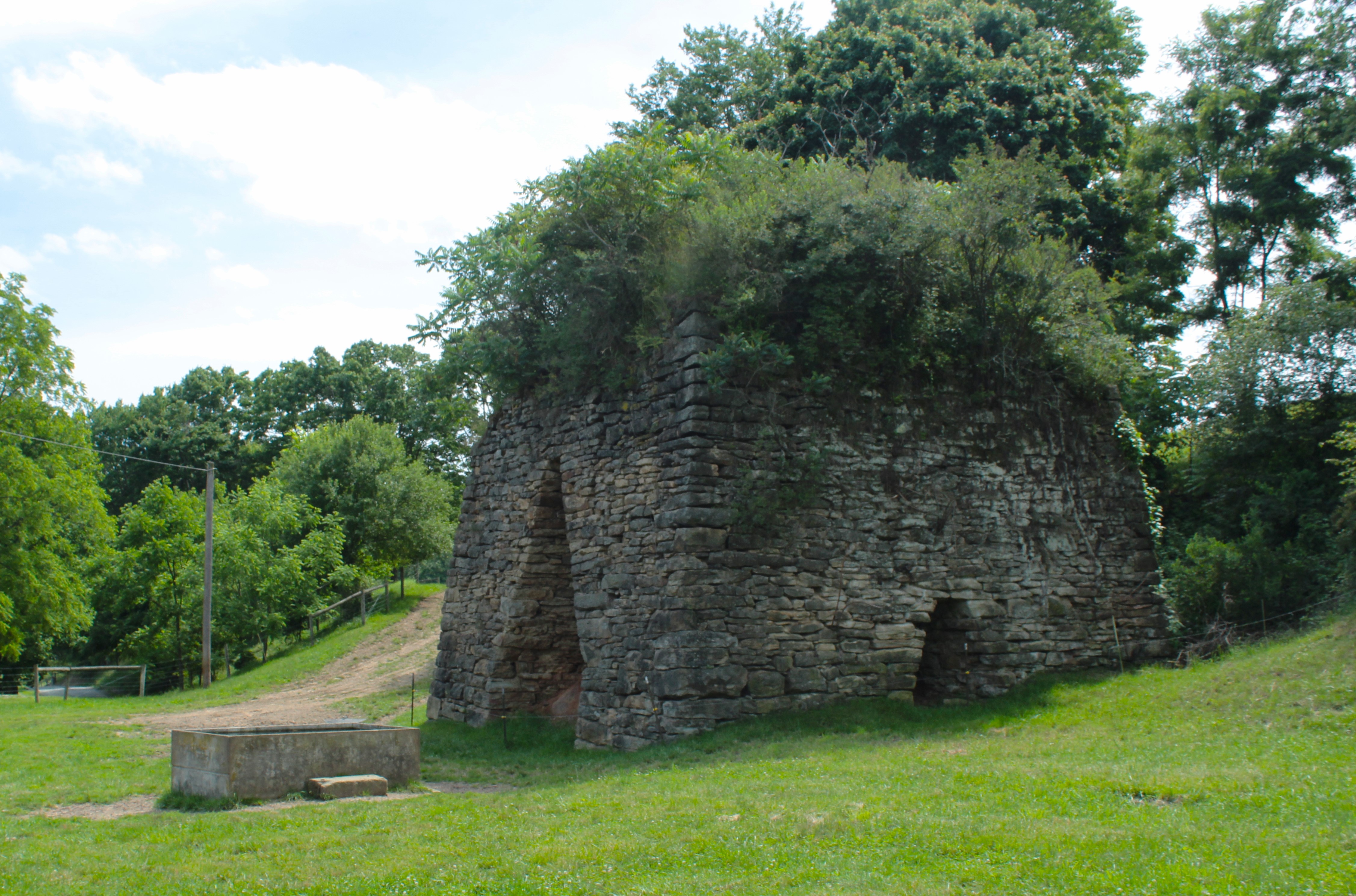
    The early furnaces were built from field stone while later furnaces tended to have been built out of quarried and cut stone. The shapes were usually the same, square based, pyramidal shaped stacks of stone. There are some that were built in a round shape but these are rather rare. Some furnaces were built with tiers or ledges and the types of arches varied from furnace to furnace, some coming to a sharp point, some rounded and others squared off. I feel as if a lot of the design depended on what was available, the builders and owner’s egos, and how deep their pocket-books were!

    Inside the furnace was the chimney, insulated from the outside by dirt and stones. Below that it widened out into the bosh where the molten ingredients combined. Below this was the crucible where the molten iron collected. There were arches on the sides, sometimes only one but usually two. Some furnaces had more. The one in the front was where the molten iron was allowed to flow out of into the molds on the casting room floor. Many furnaces also had a tuyere arch where air was blown into the furnace to increase the heat, producing better quality and more economic iron. Another arch may have been used to remove the slag from on top of the iron before it was tapped. 

    Slag was a byproduct of the iron making process that formed on top of the molten iron and had to be removed before the iron could be tapped. It hardened into a glassy mass that was easily broken and can be found near most of the old furnaces. The various colors of it are from the various chemicals and minerals used in the ingredients. 

    Air was introduced to the furnace by bellows which were operated by water wheels, powered by the near-by streams. This increased the heat of the furnace. In later years, some of these water wheels were replaced by steam engines. Like today, when a more efficient method was available, the company latched onto it. Progress always moves on!

    When the stone blocking the crucible was removed, the molten iron would flow into the casting house, a sand floored room with molds tamped into the floor. A main line ran down from the furnace with branches coming off of it. The iron in the depressions was called pig iron because they resembled a sow feeding its piglets. 

    The land around a furnace was filled with various buildings to house equipment, workers and their shops. 

    The furnaces ran day and night, new ingredients were added after the furnace were tapped. It was a noisy, smoky place to live and work!

    There were buildings for the charcoal, the iron and limestone, blacksmith and carpenter shops, stables for the horses and oxen used to transport raw materials and finished products, along with houses for the workers and their families. The workers houses were often log cabins, while the Ironmasters had much nicer residences.  If it was a larger operation, schools and stores were near-by. The longer a furnace was in operation, the bigger its footprint would be.

    Once the natural resources ran out or their prices increased beyond the owner’s means, the furnace went out of blast. Often it was because the lumber had run out. There are some furnaces that shut down because of poor quality ingredients. Some complexes continued producing iron for decades and a few, over 100 years!

    The furnaces that went out of blast usually just sat there. Over time, the buildings were torn down or rotted away, the community that sat around the furnace often moved over to another furnace, the workers were needed there and commuting wasn’t a real option in those days. Some of the building which were better made might have survived but most just disappeared. The furnaces themselves, being made out of heavy stone tended to survive longer. 

    Trees and weeds start growing in between the stonework and as the years pass by, their roots increase in size, pushing the stonework apart and causing the structures to collapse. The weather: rain, snow and ice further erode the structures. 

As decades turn into centuries, they collapse in on themselves and slowly disappear as nature grows up around them and hide them from view. Some furnaces were taken down and the stonework was used to build foundations for new buildings while some townships used them for walls and bridges.

    Some of the furnaces were taken care of and some of the nicer ones were preserved. The growths on them were pruned off and historic societies, owners and sometimes state and federal governments made displays out of them. This requires time and money and some owners just can’t afford either and so the structures are left to the ravages of time.

    This past week we took a trip to visit a couple furnaces we hadn’t seen yet. One, the Paradise Furnace was located near Raystown Lake in the Trough Creek State Park. 


    The furnace is near a small stream, built into a hillside. Stone pillars stand behind it on the hillside which held up a bridge which was used to carry ingredients to the top of the furnace for fueling. Time and gravity has pulled a lot of the furnace down. The right hand side is still standing but much of it is collapsing, exposing iron bars which helped hold it together. There are some signs near-by describing how furnaces worked but there was very little information about the furnace itself.

    It was originally built around 1830 and was named the Trough Creek Furnace, in 1832 it was renamed the Mary Ann Furnace. It became the Paradise Furnace in 1843. It remained in blast until around 1860. The demand for iron during the Civil War had it re-fired in 1865, working until 1869.


    About an hour away we came to the Franklin Furnace, a short distance away from Fort Laudon. This furnace was built in 1828, a couple years before the Paradise Furnace.  It produced iron until 1882.

    The walls of a period barn are sitting near-by as are the manager’s house/office and a couple houses where the workers lived.  There are no signs indicating that we were in a historic district (as of 1991) or what the furnace was named or where any of the historic houses were. The furnace was overgrown and had lawn clippings and trash piled in front of it. The structure is still impressive but sadly, we could have driven past it if we hadn’t been looking for it. It sits about 40 feet from the road, looking abandoned and forgotten. I wonder if the people in the neighborhood even realize or care that they live in a site that was part of our state’s history.

These remnants of the iron industry are part of its beginning. They are part of the history of the steel industry and they are part of our country’s history. They helped make us as a country become who we are now! If you ever get a chance, visit one and see how far we’ve come!

Further Reading;

          *Blair County Iron by Byron Smail  (2024)

          *Cornwall Iron Furnace, Pennsylvania Trail of History Guide by Susan Dieffenbach (2003)

          *A Guide to the Old Stone Blast Furnaces in Western Pennsylvania by Myron B. Sharp & William H. Thomas (1966)

          *Hopewell Furnace by National Park Service

          *The Iron Furnaces of the Cove by Byron Smail  (2023)

          *The Iron Industry in Pennsylvania  by Gerald G. Eggert  (1994)

          *Making Iron and Steel, The Historic Process 1700-1900 by Jack Chard (1995)

          *Pennsylvania Iron Manufacture in the Eighteenth Century by Arthur Cecil Bining (1938)

          * Study of Alternatives- Mount Etna Iron Furnace Complex by SW PA. Heritage Preservation Commission (1990)


Wednesday, January 25, 2023

A Monday Morning in January

The morning hadn’t offered me anything special, a light snow had fallen during the night, the grass wasn’t even covered. Instead of white, the world outside the window was mostly brown. The roads in the distance were wet; only the glow of the traffic lights added any color to the otherwise dismal scene.

    Sipping the first cup of coffee of the day, I talked with Ann Marie. She told me how wonderful it looked at her house, thick snowflakes and trees outlined in white. We decided to take a ride into the country, away from the city, and see what the weather had brought to others.

    With no real destination in mind, we started off heading in an easterly direction. Avoiding major highways, we basically had the roads to ourselves. Rarely did we have any cars passing or following us; we could take our time and enjoy the views.

    Occasional bursts of snow would hide the scenery from us but they passed quickly. We were treated to fields covered by blankets of snow, tall dark evergreens with white accents on their branches and wooden fences bordering the roads. Every so often we’d see fresh tire tracks cutting across the snow but we didn’t see any livestock or people outside. They were all nice and warm in their enclosures. It was a beautiful day to be out exploring even if the sky was grey.

    A large dump truck pulled in front of us and we took that as a sign to change the road we were on, so when we came to the next intersection, we took it. Left or right didn’t matter, that’s the nice thing about not having to worry about where you’re going.

    We went through woods where everything was outlined in white and went into valleys where it looked as if it hadn’t even snowed at all. We passed houses sitting below high hills, the trees covering them were all different shades of white. The dark buildings stood out against the artistic backdrop.

    In the small community of Salina, we stopped for awhile to investigate an old square chimney. Located in the ruins of a brick manufacturing plant, it sits beside a large pond full of clear water. Pallets and trash can be seen through the water along with a lot of algae. The stack and a small building reflected in the still water. 

    We got out of the car and walked around for awhile. We picked our way across piles of yellow bricks and dried knotweed and took a quick look at what appeared to be an electrical building. Not very large, it had old, vandalized and rusted equipment in it, the windows were all broken. Wooden poles were beside it with crossbeams and insulators on them. Wires no longer connected to anything electrical. The chimney sat in a pile of debris and so, we didn’t get too close to it. What appeared to be a brick opening sat on the other side of a swampy area, we decided to skip visiting it also. (Another time perhaps)

    The plant once belonged to Kier Brothers. Established in the mid 1800’s it was once a major supplier of fire bricks. It eventually was bought by General Refractories Company who ran it until it closed in 1981. 

Approximately 1900

    In 1919, there were 50 men and boys working here, producing 14,000 bricks a day. The bricks were used in industrial furnaces and other high heat applications.

     There were at least two mines at this site where they got fuel and raw materials for the bricks. On an internet site, there was a mention that a mine shaft was right beside the furnace, (see the map above) going in at a 15 degree slope. It eventually went below the surface level of the near-by Kiskiminetas River and needed to be pumped out so that the mining could continue. This might explain the pool of water. In the picture of the chimney and the pond, there appears to be a gated opening underneath the “power” house, this probably is where one of the mines was located. The cold weather started getting to us so we returned to the heat of the car and continued our drive.

    We eventually ended up in the town of Apollo. There we stopped at Dolly’s Diner, an actual old-style diner. Recently moved to the present site from just about a block away, this was just what we needed; a place to get a good meal, with an enjoyable atmosphere.

    We sat at a booth beside the front window, across from the counter. A pair of “regulars” sat in the booth behind us discussing politics and sports. 50’s music played in the background. The coffee came quickly, fresh and dark. We placed our orders and talked about our adventures so far.

    A couple sunny-side up eggs, two slices of bacon and some buttered wheat toast fueled me up for the return trip. The coffee was refilled frequently. As the noon hour approached more customers showed up, we had timed our visit perfectly. After paying our tab we returned to the car satiated and ready for the final leg of our journey.

    The day had been perfect for a drive in the country. In the warmer valleys it had appeared as if no snow had even fallen while on the hilltops it was a winter wonderland. Above the valleys we drove through a country covered in white.

    We found our snow; we visited a “historic” site, ate at an old comfy diner and even saw some “wildlife”! (see the picture above) We made it back home in time to catch an afternoon nap….or maybe I should say, to do some chores. (Yeah, that sounds much better!) Either way, it was great morning!


Tuesday, June 21, 2022

Slippin' Into The Past

 The past is all around us, the buildings in our neighborhoods and towns, the technology we hang onto, the faces we see in the mirror and the memories we hold in our in our thoughts. Some of these memories stick with us and others tend to drift into the deep, depths of our brain cells.

    During the past few months I have been copying the black and white negatives I had taken 30 or 40 years ago. This was during the midst of my darkroom days, photos taken with celluloid, light sensitive film. Pictures would be taken, the film developed and then hours spent in the darkroom trying to get that one, “special” picture.

    When moving into my present home, the darkroom and film developing was left behind. (The processes, not the equipment!) The age of the digital camera was rapidly taking over the photographic market. My developing started going to commercial companies rather than my basement.

(1985?)

    The Pittsburgh area had lots of camera stores in those days and when pictures were needed there a couple excellent places where enlargements could be made. It was amazing how many hours were saved by doing this! Never the less, I miss those days in the darkroom!

    While copying these negatives onto my computer, I was continuously being reminded of the places and adventures I had experienced. That and the people I shared them with. Most of these weren’t forgotten, they just hadn’t been thought of for decades. Seeing pictures of landscapes which have changed because of buildings being built or removed is reliving history. The cars are dated and signs reflect the times, they are showing us the past.

    Trips taken, places visited, experiences... Here are a few shots I’ve recently uncovered and re-remembered. Just a little bit of my own personal history!

Entrance to the Waterworks

(1984)

    The city of Pittsburgh had a water treatment plant where the Waterworks Mall is now located. There were acres and acres of underground filtration beds, unused because of more efficient means of purifying the city’s water. They were abandoned and used only for parties and visits by urban explorers. A parking lot now occupies the spot where this shot was taken.

The Civic Arena

(1986)

    Before the Civic Arena was torn down, it was a premium spot for concerts and sporting events. The arena was equipped with a domed roof which could be opened, allowing fresh air in. (and letting “smoky” air out) It was always exciting to see the roof open. In the background, the Veteran’s Bridge was still in the process of being built. The dark building in the center was once the Pennsylvania Railroad headquarters. During the 60's it had been scheduled to be demolished but the Pittsburgh History and Landmarks Foundation managed to stall the destruction of this building. It is presently the location of the Amtrak station with apartments above, called The Pennsylvanian.

5th Ave, when people used to fill the streets

(1987)

      Pittsburgh is a major city and the sidewalks showed it. The storefronts were all occupied and when one closed, another took its place in no time. The buildings were filled with offices and the workers crowded the streets as their work days ended.

Early morning at DeLuca’s 

(1987)

    There were diners all around the city but some of the best were located in the Strip District. They didn’t cater to sightseers and tourists as much as to the working men and women of the city.

Pencil Vendor in NYC

(1989)

    On a trip to New York City I was amazed at the size of both the city itself and the population. My camera got a good workout as I explored the town.

The start of demolition at the Syria Mosque

(1991)

    Early in the morning, I took a ride into Oakland to watch workmen remove the 2 Lions from the entrance of the Syria Mosque. After they put the lions on a truck and drove them away, the bulldozer moved in and started with the roof covering the main entrance. I had my high school graduation ceremony there and spent many a night watching my favorite bands perform in it.

Amtrak and Circus trains at the Pgh. Station

(1992)

    Amtrak still stops at the Pittsburgh station but the circus trains are a thing of the past. I watched a couple parades where they marched the elephants up to the Civic Arena. The last year I saw it, they were trucked up from the RR station in the early morning. The excitement of the circus was waning.

Workers building a sculpture in Pittsburgh

(1986)

    I liked how the workers placing the cobble stones mirrored the sculpture mounted on the wall. The wall is what's left of an old building. This is pure Pittsburgh, always re-building itself!

    It's just a couple pictures, a quick journey into the "good old days". I shudder to think how many more pictures are “stored” in the attic. That will be in my future…exploring the past!


The Pittsburgh Book Crawl 2026

  The past week was miserable. Not only were the temperatures in the high 80’s and above, on Thursday we were attacked with the smoke from t...