Showing posts with label slag. Show all posts

Thursday, July 4, 2024

Stepping Back in History

Back in the 17th and 18th centuries one of our ancestors' needs was for good quality tools and to get these, they needed metal. The Pennsylvania hillsides have numerous fields of iron ore and to turn this ore into metal they built furnaces. By putting the ore into a furnace along with a couple other necessary ingredients, they were able to produce iron.

    To remove the iron from the ore, it has to be heated extremely hot and then to separate the molten iron from the un-needed impurities a flux was needed. Limestone (and sometimes oyster shells) provided that element. For the heat the first furnaces were fueled by charcoal, made from the trees which grew around the furnace. Later, coal was used and then coke.

    Furnaces were most often built where these main ingredients were located, saving the owners transportation costs. The charcoal was made by chopping down trees and stacking the logs in piles. The colliers, the men who made the charcoal would light these mounds and let them smolder. Their job, a rather dangerous one, was to make sure that the piles didn’t catch on fire. Woodcutters played a very important part of this process since it could take 300-350 acres of timber to keep a furnace in blast for a year! Once the charcoal had cooled it was put in a dry spot until it was needed, usually very close to the furnace. Iron ore and limestone were also brought to the site and kept close at hand.

    The first iron furnace in Pennsylvania was the Colebrookdale Furnace on the outskirts of Boyertown, built in 1720. The first furnace west of the Alleghenies was the Alliance Furnace built in 1790, on Jacobs Creek, not far from Perryopolis. A furnace was built in Pittsburgh around 1792 but it lasted only a couple years before the ore ran out. The Shadyside Furnace was built where Shadyside is today, no evidence of it remains.
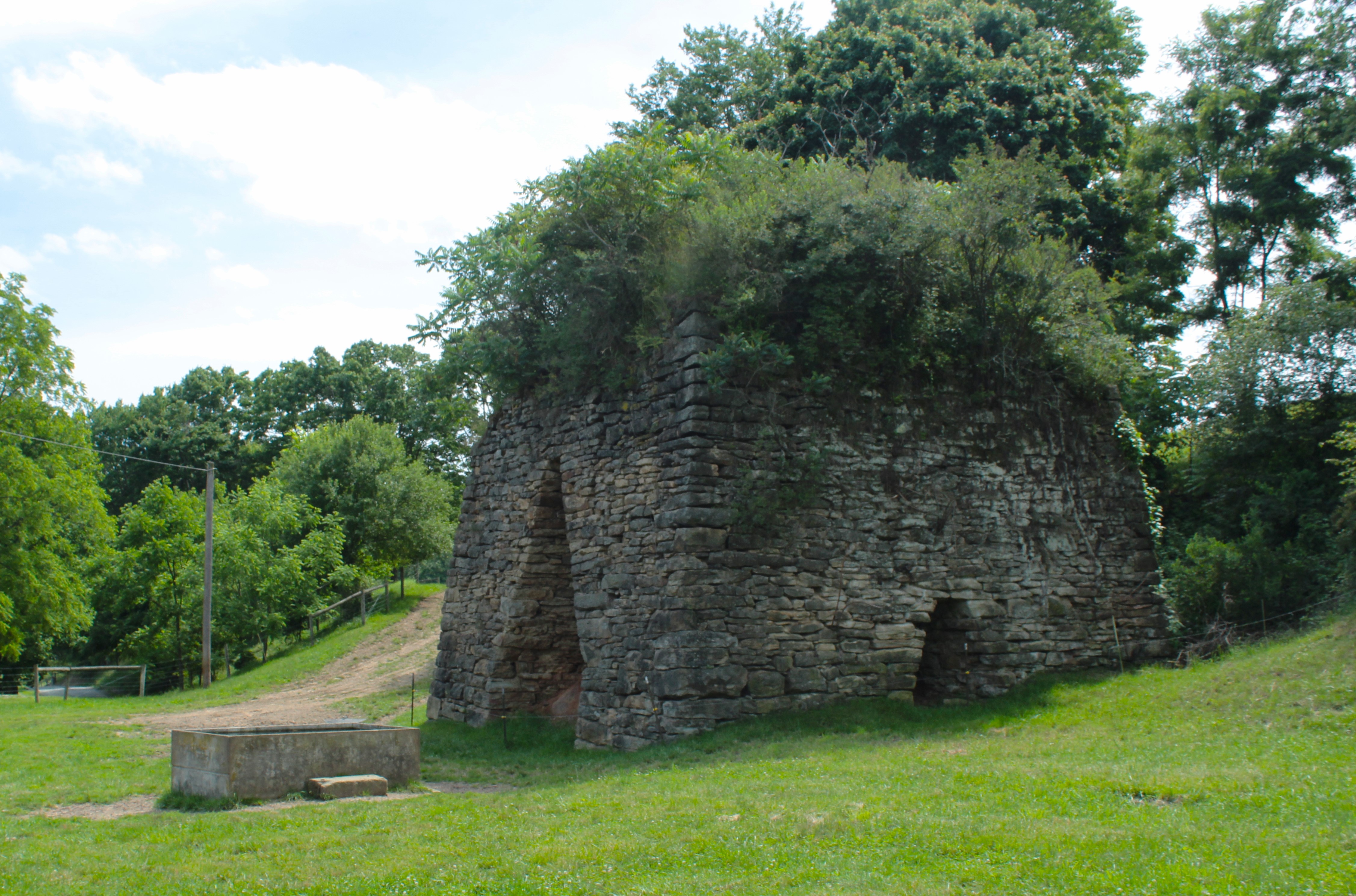
    The early furnaces were built from field stone while later furnaces tended to have been built out of quarried and cut stone. The shapes were usually the same, square based, pyramidal shaped stacks of stone. There are some that were built in a round shape but these are rather rare. Some furnaces were built with tiers or ledges and the types of arches varied from furnace to furnace, some coming to a sharp point, some rounded and others squared off. I feel as if a lot of the design depended on what was available, the builders and owner’s egos, and how deep their pocket-books were!

    Inside the furnace was the chimney, insulated from the outside by dirt and stones. Below that it widened out into the bosh where the molten ingredients combined. Below this was the crucible where the molten iron collected. There were arches on the sides, sometimes only one but usually two. Some furnaces had more. The one in the front was where the molten iron was allowed to flow out of into the molds on the casting room floor. Many furnaces also had a tuyere arch where air was blown into the furnace to increase the heat, producing better quality and more economic iron. Another arch may have been used to remove the slag from on top of the iron before it was tapped. 

    Slag was a byproduct of the iron making process that formed on top of the molten iron and had to be removed before the iron could be tapped. It hardened into a glassy mass that was easily broken and can be found near most of the old furnaces. The various colors of it are from the various chemicals and minerals used in the ingredients. 

    Air was introduced to the furnace by bellows which were operated by water wheels, powered by the near-by streams. This increased the heat of the furnace. In later years, some of these water wheels were replaced by steam engines. Like today, when a more efficient method was available, the company latched onto it. Progress always moves on!

    When the stone blocking the crucible was removed, the molten iron would flow into the casting house, a sand floored room with molds tamped into the floor. A main line ran down from the furnace with branches coming off of it. The iron in the depressions was called pig iron because they resembled a sow feeding its piglets. 

    The land around a furnace was filled with various buildings to house equipment, workers and their shops. 

    The furnaces ran day and night, new ingredients were added after the furnace were tapped. It was a noisy, smoky place to live and work!

    There were buildings for the charcoal, the iron and limestone, blacksmith and carpenter shops, stables for the horses and oxen used to transport raw materials and finished products, along with houses for the workers and their families. The workers houses were often log cabins, while the Ironmasters had much nicer residences.  If it was a larger operation, schools and stores were near-by. The longer a furnace was in operation, the bigger its footprint would be.

    Once the natural resources ran out or their prices increased beyond the owner’s means, the furnace went out of blast. Often it was because the lumber had run out. There are some furnaces that shut down because of poor quality ingredients. Some complexes continued producing iron for decades and a few, over 100 years!

    The furnaces that went out of blast usually just sat there. Over time, the buildings were torn down or rotted away, the community that sat around the furnace often moved over to another furnace, the workers were needed there and commuting wasn’t a real option in those days. Some of the building which were better made might have survived but most just disappeared. The furnaces themselves, being made out of heavy stone tended to survive longer. 

    Trees and weeds start growing in between the stonework and as the years pass by, their roots increase in size, pushing the stonework apart and causing the structures to collapse. The weather: rain, snow and ice further erode the structures. 

As decades turn into centuries, they collapse in on themselves and slowly disappear as nature grows up around them and hide them from view. Some furnaces were taken down and the stonework was used to build foundations for new buildings while some townships used them for walls and bridges.

    Some of the furnaces were taken care of and some of the nicer ones were preserved. The growths on them were pruned off and historic societies, owners and sometimes state and federal governments made displays out of them. This requires time and money and some owners just can’t afford either and so the structures are left to the ravages of time.

    This past week we took a trip to visit a couple furnaces we hadn’t seen yet. One, the Paradise Furnace was located near Raystown Lake in the Trough Creek State Park. 


    The furnace is near a small stream, built into a hillside. Stone pillars stand behind it on the hillside which held up a bridge which was used to carry ingredients to the top of the furnace for fueling. Time and gravity has pulled a lot of the furnace down. The right hand side is still standing but much of it is collapsing, exposing iron bars which helped hold it together. There are some signs near-by describing how furnaces worked but there was very little information about the furnace itself.

    It was originally built around 1830 and was named the Trough Creek Furnace, in 1832 it was renamed the Mary Ann Furnace. It became the Paradise Furnace in 1843. It remained in blast until around 1860. The demand for iron during the Civil War had it re-fired in 1865, working until 1869.


    About an hour away we came to the Franklin Furnace, a short distance away from Fort Laudon. This furnace was built in 1828, a couple years before the Paradise Furnace.  It produced iron until 1882.

    The walls of a period barn are sitting near-by as are the manager’s house/office and a couple houses where the workers lived.  There are no signs indicating that we were in a historic district (as of 1991) or what the furnace was named or where any of the historic houses were. The furnace was overgrown and had lawn clippings and trash piled in front of it. The structure is still impressive but sadly, we could have driven past it if we hadn’t been looking for it. It sits about 40 feet from the road, looking abandoned and forgotten. I wonder if the people in the neighborhood even realize or care that they live in a site that was part of our state’s history.

These remnants of the iron industry are part of its beginning. They are part of the history of the steel industry and they are part of our country’s history. They helped make us as a country become who we are now! If you ever get a chance, visit one and see how far we’ve come!

Further Reading;

          *Blair County Iron by Byron Smail  (2024)

          *Cornwall Iron Furnace, Pennsylvania Trail of History Guide by Susan Dieffenbach (2003)

          *A Guide to the Old Stone Blast Furnaces in Western Pennsylvania by Myron B. Sharp & William H. Thomas (1966)

          *Hopewell Furnace by National Park Service

          *The Iron Furnaces of the Cove by Byron Smail  (2023)

          *The Iron Industry in Pennsylvania  by Gerald G. Eggert  (1994)

          *Making Iron and Steel, The Historic Process 1700-1900 by Jack Chard (1995)

          *Pennsylvania Iron Manufacture in the Eighteenth Century by Arthur Cecil Bining (1938)

          * Study of Alternatives- Mount Etna Iron Furnace Complex by SW PA. Heritage Preservation Commission (1990)


Saturday, May 18, 2024

Searching for Stones in the North

 Cautiously I entered what appeared to be a large bowl, the dirt was layered with different colors and hues. The surface looked hard but it crumbled as I ran my finger across it. I could easily stamp steps into it should I need to.

    An abandoned cement block building sat near the entrance with a large high tension tower sitting behind. Trash and barrels sat around the building with a half open garage door at its far side. I’d come back to that later.

    The bowl was large, maybe 40 or 50 feet across. It looked as if it had been formed by the wind or by water. A small opening was on one side of it, the edges rounded by time. Glancing inside I saw a small hole in the roof near the back, the light filtering in illuminating the small space, highlighting the variations in the coloring of the surface.

    I was searching for…something, I wasn’t sure what. I knew it was near-by and I knew I would know it when I saw it. Whatever it was I knew it was important! Suddenly a alarm started ringing and I abruptly left my dreams and returned to reality. It wasn’t an alarm; it was my bladder that was calling. Much as I wanted to go back and find whatever I was looking for, I knew it would be useless, my dream and my sleep had been left behind!

    I knew that the idea of sleep was impossible, the alarm beside my bed was set for about an hour later. I knew I would just toss and turn. There was another trip on my calendar and the excitement of it wouldn’t let sleep slip in! I gave up and made some coffee.

    A few hours later, I met Frank Festa and his buddy Jeff at a local gas station. After a cup of coffee and some light BS we loaded my gear into his car and we headed north on rt.8.

    We were going on an iron furnace tour. Frank and Jeff are also “experienced furnace hunters”. We had already been to the furnaces on our list but it was the idea and the excitement of seeing them again and comparing them to how they looked when we were there last, ½ a year or even 10 years ago, that brought on this trip.

    Our first stop was to the east of Harrisville, on Creek Bottom Rd. We parked the car and dropped over the hillside, looking for the Marion Iron Furnace, or what was left of it.

    Entering the woods I was reminded of a tropical rain forest. The ground and branches we passed under were all wet. It was warm and everything was green. Other than the birds chirping, all was silent except for our footsteps. The logs were covered with moss and skunk cabbage was sprouting near the creek. Ferns were everywhere. Our pant legs were drenched almost immediately. Mosses on the rocks made them blend in with everything else, making walking difficult. Moving up the stream I didn’t see the furnace and I started doubting my memory and then I saw it, a large mound of rocks, green like everything else.

    The furnace sits right in front of a water channel built at the same time as the furnace. The Marion furnace is listed as being built around 1848-1850. It produced iron only until 1862. A short distance upstream from the furnace sits the remains of a dam which fed the channel in front of it. I imagine there was a water wheel here at one time.

    Only one opening remains. The rest of it is just a pile of green stones. Above it was the plane of an old road and downstream from it we found both a couple pieces of iron and LOTS of slag. The slag is a byproduct of the iron making process; it needs removed from the top of the molten iron before the iron can be poured into the molds, called pigs.

    We left the furnace and headed NW towards Mercer crossing beautiful farms interspersed with batches of woods. We passed a weird stone structure on our way so naturally; we stopped to look and photograph. We have no idea what it is or was.

    Further on up the road we came to the first of two similarly named furnaces. Which one is really the Iron City Furnace is unknown but for us, I will call the first, Iron City Furnace North and the second, Iron City Furnace South. The two furnaces lie about two miles apart.


    The first, (ICFN) sits near a golf course. It is rather small and looks as if it was built into a hillside. Was it an iron furnace?  There is only one opening visible and has a rather large opening on top. There are no loose stones lying around and no visible slag in the near-by stream. The stones which make up the outside of furnaces are often taken to build other structures after the furnaces are shut down. The topography of the land often changes also, some of the furnace could still be underground, and the small opening could be the top of a much larger opening. (?)

    There is signage which says the furnace was built in 1838 and a bit downstream is a poorly made, plywood waterwheel hung across the stream. The near-by wooden bridges and rope handrails are showing their age and I chose to walk across the stream rather than chance using the bridges.


    The second furnace, (ICFS) isn’t much more than a large pile of stones. Wild rose bushes and other brush cover it, making it hard to get a complete view of it. Several courses of stone can be seen still standing in places and I know from a previous visit that one of the openings is still there, though protected now by fallen sticks and many heavily thorned branches. By forcing your way though the heavy brush, you can see the chimney opening

    The side furthest from the road, probably where the casting opening was has many stones visible, tumbled against one another. On this side there are many pieces of slag lying around on the ground, something we didn’t notice at the previous furnace

    This caused us to think that the first one (ICFN) was a smaller furnace, possibly used to reheat the iron to further form it into shapes to be used elsewhere. The second furnace (ICFS) seems so much larger and has the debris related to iron furnaces scattered around it. We may never know.

    The bible for old iron furnaces hunters written by Myron Sharp and William Thomas, A Guide to the Old Stone Blast Furnaces in Western Pennsylvania, says that the Iron City Furnace was built in 1846 or possibly 1838 and went out of blast by 1865. The directions in it SEEM to be for the second (ICFS) site.


    Our journey then took us further south, not far from Volant below a beautiful waterfall. The Springfield Furnace was built here around 1837 and produced iron until 1862. A sign posted beside it calls it the Seth and Hill Furnace, noting that it was the first furnace built in Mercer County. The furnace remained in use until 1867. It had a huge 18 foot waterwheel that was powered by the water flowing over the falls. Remnants of the waterway can be seen leading towards the furnace when viewed from above.

    The furnace was partially covered in dirt and was later dug out by owners of the property. A jewelry store used to be located above the furnace, some of the items they sold was jewelry made out of the slag found around the area. A brewery sits here now and some of the paths leading to their outdoor seating are covered with crushed slag. Slag is everywhere you look here! The ruins are included in the brewery’s location, a fire ring sits in the mouth of the furnace and Corn-hole boards sit near-by the tables scattered on the patio around it. The area is more an entertainment venue than a historical site.

    The sound of the water pouring over the falls was with us as soon as we opened the car doors. Being a big fan of old iron furnaces, I would have to say that the falls were my favorite thing about this site. Chances are we (AMB and I) will visit here again; the idea of sipping on a mug of beer and sitting by the falls for an hour or two sounds pretty good!

    The next stop was on the edge of McConnell’s Mill State Park, alongside Slippery Rock Creek. This is where perhaps one of the best preserved iron furnaces in Western Pennsylvania sits. The Wilroy furnace was built in 1854. It is very difficult to get to and perhaps this is one of the reasons it is so well preserved. People upstream have the land posted and on the other side is a highway. The stream is wide and rarely shallow enough to cross by foot. This results in a furnace with no trash around it and no graffiti. Someone has kept up with occasional clearing of near-by trees and shrubs and there aren’t any major trees digging their roots in between the stones.

Taken in April of 2022

    The furnace has 5 tiers of stone with three openings. A small bit of stone has fallen from the top but the majority of it remains. I can only hope it will become available to furnace lovers in the future!

    Ann Marie and I have visited it a few times but on this trip we weren’t able to get near it. We had to view it through the trees from the far side of the stream. What little we could see of it still looked magnificent!

    About fifteen miles further south brought us to the far end of the Zelienople Airport. A nice big sign greeted us as we pulled into in a small parking area. A wide path led us into the woods to a pile of rocks which was all that remains of the Bassenheim Iron Furnace. Though the airport is in Butler County, the furnace sits across the county line in Beaver.

    This furnace, built in 1813 was one of the first iron furnaces in Western Pennsylvania. It produced about 5 tons of iron a week during the ten years (+/-) it was in blast. We slipped down the steep hillside beside it to the creek below hoping to be able to see more of it but thick brush covered anything that might be there. We found a couple pieces of slag in the stream but not much more. Above, only the top of the furnace is visible, just a couple courses of rock and that is rapidly becoming overgrown with foliage. Should you want to force your way to the top, the chimney opening can be seen. This was the least exciting furnace we visited.

    From there we headed back to where my car was parked. The trip was a success, we visited one more furnace than what we had planned, the weather was just right for a trip, and the good companionship made it even better! We were on the road for about eight hours; eight hours well spent!

    There is something I find fascinating about finding these remnants of what used to be a thriving community and business. Everything is gone, the buildings, the houses and the machinery. Unlike the past these sites are quiet. Occasionally there are walls still standing, that used to hold equipment, control the earth’s movement or to diverge water but most often, it is only the stones which made up the furnace that remain, piles of stone, continuously being hidden by nature. 


Fifty Years

  On the day our country celebrates its 250 th birthday, I will be celebrating another anniversary. It was on the 4 th of July, 1976 that ...