Saturday, October 7, 2023

Going to the Maps


I had just finished reading “The Cartographers” by Peng Shepard and was thinking about it. It was about maps and how they have the potential for making places real. While the book was about using a map as a key to entering a place no one else could go to unless they held the map, I’ve always thought that maps made things real to us. By showing us the way to go, we can experience places that we’ve only heard about.

    Every time I go on a trip, or even think about the possibility of going on one, I go to my maps. Atlas’s, gazetteers, simple folded gas station maps, (remember those?) and even the simple to use, internet maps, I use them all. Looking at them I can decide which routes to take, I can determine whether it will be a quick speedy journey or a scenic one. I can find places to stop and places where things can be found and uncovered. Maps are as important to me as my books are!

    I recently saw a picture of an old furnace that someone had posted. My curiosity piqued, I pulled out my reference materials.

    The first step was to check a book I have about iron furnaces. Published during the second half of the last century, A Guide to the Old Stone Blast Furnaces in Western Pennsylvania, written by Myron Sharp and William Thomas, has been invaluable to me, helping me find numerous old furnaces. Some were mere piles of rock, a few were empty fields or parking lots but there have also been a lot of exciting structures found. Some are hidden deep in the woods, inaccessible to anyone except those who don’t mind a bit of discomfort in their exploring. Some are sitting in plain sight beside the road. This book has taken me to numerous furnaces which while being over 100 years old, still show the mastery of the men who put them together!

    With a little more information about the furnace, I turned next to my Pennsylvania Gazetteer and tracked down the roads mentioned in the book. I also checked a couple other books I have to see if there was any mention of the furnace in them. I added more notes to my list and then I moved into the present century and the computer.

    I visited a favorite search site called Waymarking.com. They have a category called Iron Furnace Ruins which consists of seven pages of furnaces located around the world. I quickly found the furnace I was thinking about going to and clicked on it. I was presented a couple pictures and a GPS location! I copied them all. I put a mark on a map indicating where it was located.

    With Google Maps, I had a good idea of what the countryside looked like, the satellite view showed me near-by road marks, places which would help keep me on track.  On-line topographic maps helped me see what kind of hills and valleys I might encounter.

    I also searched the maps on Geocaching.com to see if there were any hides in the area. A new cache had been listed at a site that I had visited before, near another iron furnace. Located with-in 10 miles of the other, as the crow flies, I added it to the list also!

    I compared maps and made a route which would take us on a nice, scenic route, making sure to pass a few geocaches on the way. I avoided any toll roads and we would only take one expressway for about 5-10 miles. The ride would be an enjoyable one!

    On Thursday morning, I had my gear packed in the car and was enjoying a cup of coffee when Frank arrived. A bit earlier than planned but that was expected, neither of us has a problem with early starts. We hit the road well before the sun rose. Our first geocache was found with the aid of a flashlight. Soon after, the sky in the east started showing its colors.

    We made a brief photo stop at the Country Kitchen, its egg showing up nicely in the predawn light. A couple caches later, we hit route 80, just a little after 8. The slanting sunshine of the morning gave the trees even more color, making the ride a visual experience.

    We were getting closer, the Alleghany River had a slight covering of mist on it as we crossed it into Emlenton, then we headed back up out of the river valley to the hill tops.

    We found another cache less than a mile away from the furnace. Hidden on a small open grate bridge, it gave us another opportunity to get out and stretch our legs as we were looking. We signed the log and re-hid it and then drove another quarter mile where we encountered a gate. Parking here, we slung our camera gear over our shoulders and proceeded on foot. The trail was a gravel/ dirt road, going on a slight uphill slant before dropping down into the valley. Going down, we could see the road leveling off ahead of us and as we rounded a curve, our GPSs told us we had arrived.

    A slight rise in the surrounding weeds was all we could see, the sunlight coming from behind the furnace further hid the structure from us. We took a “path” which led towards where we thought it would be. As we pushed through waist high weeds and crossed over hidden fallen trees the stones of the structure started to appear to us.

    Surrounded by the weeds and bushes it was hard to get a whole view of the furnace. Vines grabbed at our feet and thorns tore at our clothes and skin. We couldn’t see where we were planting our feet, we could only guess and hope.


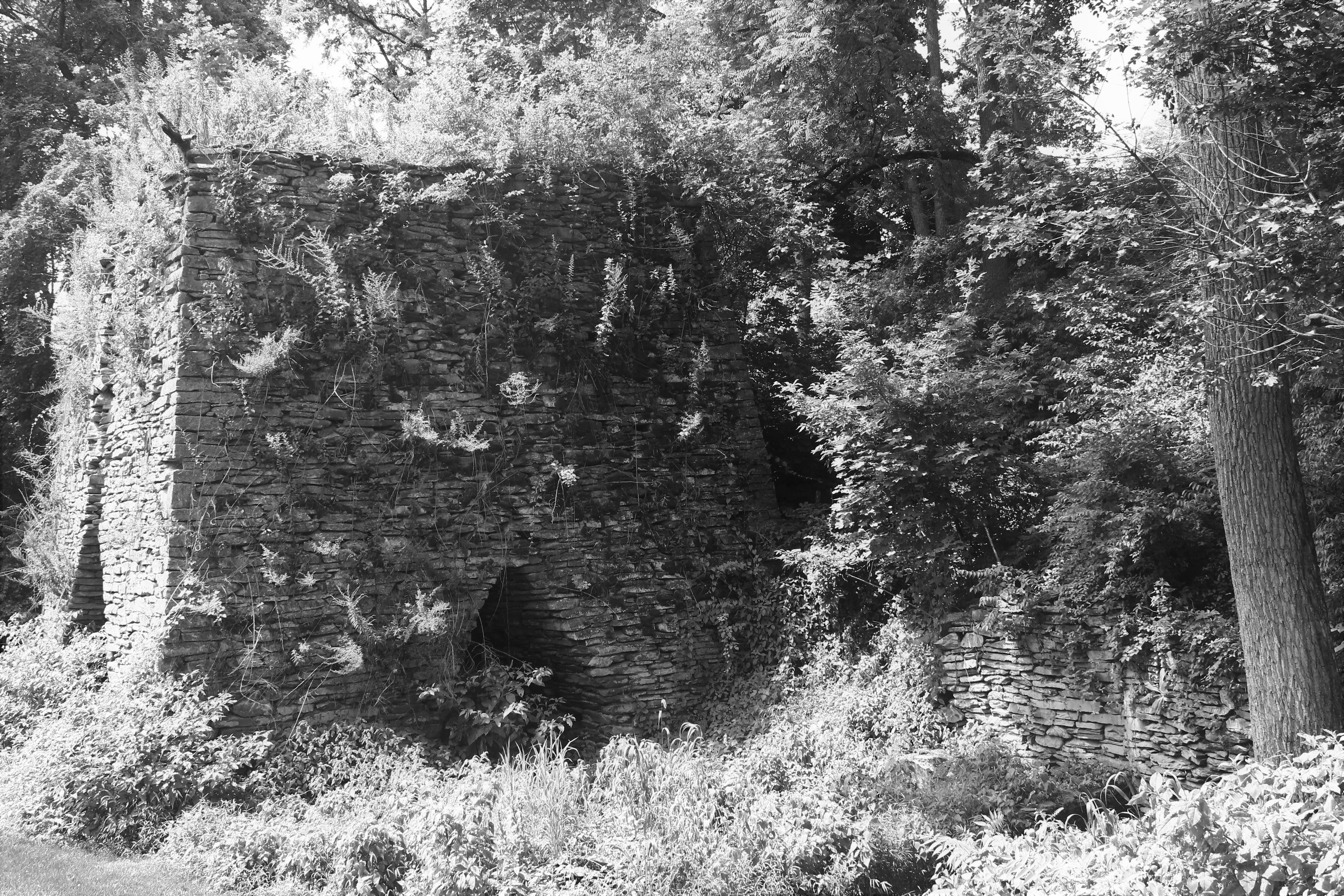
    Finally, there it was, the Webster Furnace. It was built back in 1838 and operated for an unknown amount of time. It went out of blast when the owners went bankrupt. What makes this furnace exciting is that the base is square like most furnaces, but the top portion has an octagonal shape covering the chimney, an eight-sided top!

    The furnace is in fairly good shape but trees have grown on top of it and their roots are slowly pushing the blocks apart, leading to its eventual demise. The underbrush made it difficult moving around it and seeing anything such as a mill race or walls, if there were any.

    After my photographic lust had been quenched, we packed up and started back up the hill. It was only seven tenths of a mile but it seemed to me to be further on the way up!

    We drove through the picturesque town of Franklin and stopped for two more caches before heading back towards home. The first was a failure; we couldn’t locate it and after a few minutes, continued on the final cache. Sometimes you’re lucky and sometimes, you just strike out…

    The second cache was great, in my opinion. We parked alongside the road and had to crawl over a deer fence. This put us at the top of a semi-deep valley. Most of the hillside was steep but there were a couple ramps which allowed access. Crossing a small stream, the furnace slowly revealed itself, sitting among the yellow fall leaves, hidden in plain sight.


    This was the Victory Furnace, built in 1843 and worked for about 7 years before it went out of blast. It is a nice tall furnace, the edges still sharp and square but it does have a few big cracks in it, one large one going up its front. I passed some cut rocks as I approached, possibly from the millrace or some other structures. There are supposedly ruins of the charcoal house on the hill behind it, I didn’t climb up to see but the idea of another trip has started to grow in my mind! Perhaps when the leaves have fallen and the sight lines are better.

    This wasn’t the first time I had visited the Victory Furnace. My first visit was because of another geocache. I stopped here early in the morning on a cool fall day in 2008. The valley was filled with fog and the sun was just rising, the area was dark, but that wasn’t going to stop me. It was a day that caused my imagination to wander.

    At the bottom of the hillside, I came to the stream. It had steep banks and I had to look around to find a place where I could get down to the water level. Splashing across the shallow stream, my GPS showed the cache only 50-60 feet away. Scrambling up the steep bank, the furnace revealed itself to me. Coming out of the fog, it resembled an ancient temple, much like in an Indiana Jones movie. With my heart beating and adrenalin pounding through my veins, I made my way through the fog and the weeds to the base of the furnace.

    Sitting alone in the valley, it appeared as if it had been dropped here. There were no roads or trails that I could see and no signs of any other ruins near-by. It was a mystical experience and the worst thing about it was that there was no one with me to share it with. It was one of those days that I’ll never forget!

    After spending some time finding the cache and taking pictures, Frank and I re-climbed the hill and returned to the car. In my mind, this was the best cache of the day! In another hour (or so) we were back at my house. Frank continued on to his home and I went in to change out of my dirty clothes and look for ticks. (none found!)

    I looked at my pictures and got a bite to eat and then sat down and started thinking…when could I go back to that last furnace?  

  I already have the maps…


Friday, September 22, 2023

Going to the Follies

 It was Thursday morning and the weathermen were gushing over what a nice day it was going to be. Officially, there were only three more days of summer left. Listening to the radio as I lay in bed, willing myself to get up, I decided to take a walk and I knew exactly where I was going to go.

    An hour or two later I was driving down a narrow neighborhood street in Highland Park. I pulled in-between two cars parked along side of the road and got out. I slid my camera gear over my shoulder and turned on my GPS. Locking the car, I walked over to a barely noticeable path leading into the woods and stepped in.

    Dropping down into a valley, the trail starts out on a set of brick steps with a thick handrail beside them. A finial sits atop the metal post at the bottom, giving credence to it being built many, many years ago. Putting nice finishing touches on things such as these are rarely done these days.

    There used to be a sidewalk at the bottom of the steps, it has since washed away with only occasional pieces of brickwork scattered across the steep slope. The pathway goes around theses remnants rather than across them, the angle they sit on makes them unsafe and also, unnecessary.

    Passing a small spring, I maneuvered around a fallen tree. The well-worn path showed me the way. After this, the trail leveled off, to one side was the drop into the valley and to the other, a steep hillside filled with tall weeds. I rubbed across a bush and was rewarded with some swollen bumps which thankfully, itched rather than stung. I nearly grabbed a thick stalk for balance when I realized that it was covered with thorns and sharp needle-like hairs. Luckily, I pulled my hand back before I touched it. The path was mainly dirt but there are numerous large stones imbedded in it, the hillside is covered with them. A careful eye was needed to avoid tripping.

    It wasn’t a long walk and the day was perfect for it. The trees kept the sunshine off of me and kept me cool. Spots of sunshine slipped through the trees illuminating the batches of white snakeroot and pokeweed covering the slopes. The sounds of cars had disappeared, there was no one around and even the birds seemed quiet, it was a peaceful and relaxing setting.

    I passed under a low hanging bush and saw what I had come to see. Sitting in front of me, lying on its side was what looked like the top of a castle turret. Round, about 10 foot tall, made out of hewn stone, cemented together. It was a remnant of the folly that used to sit in the backyard of the house at the top of the hill.

    A folly is an ornamental building which serves no purpose except to stimulate the imagination. It has no historic relevance. Follies are popular in England and Europe, putting a set of ruins in the middle of a field or lawn adds an eye catcher to the scene.


From Landmark Architecture

Pittsburgh and Alleghany County

1985

Date unknown

    This particular folly was built in the late 1800’s by Robert King who later inherited the house from his mother. It consisted of four towers with crenellated tops, looking much like a rook in a chess set. They were complete with doors and small arrow windows looking out into the valley. Walls connected them, looking much like the walls of a castle or fortress. The yards, gardens and the folly were well kept and maintained during his and his wife’s lives. After they passed on, the land was donated to the city and it became part of Highland Park. The folly was no longer cared for and over the decades has slowly crumbled and fallen over the hillsides of the valley. Today, only one tower remains standing, along with the remnants of some of the walls below. The house has since been sold to a private owner. Even though I know better, I feel as if I am in a historical site, and in a way, I am.

    First things first, there is a geocache in the near-by area. I un-slung my camera bag, took my GPS and started searching. Five minutes later, the cache had been found and the log signed. One of the things which first interested me in geocaching was the various places the game would take me to, places such as this!


    Returning to my camera gear, I got out the cameras and took some pictures. There are lots to see on the hillside, I enjoyed myself walking around and finding different places to shoot, shots I hadn’t taken on previous visits. The heat of the day was increasing and the bugs had located me, so I packed up my gear and returned to the path and the car.

     Having been in the woods for just a little over an hour, I came back to a ticket stuck under my windshield wiper. It seems I had picked the one day of the month that the street gets cleaned. On the sign located halfway down the block, it lists the two-hour period (of the month) that cars couldn’t be parked here. I could see the marks on the street showing that the street sweeper had passed by, I also could see the tickets stuck on the cars parked around me.

    So, I had taken my walk, found a geocache and had taken some pictures. I also got some exercise and was relaxed and calm, this was all good! The only down side of the morning was that it cost me a little more than I originally planned. I guess I found two follies all together, the ornamental buildings with no purpose other than decoration and my own lack of good sense; not checking the signs better. Oh well, live and learn!


Tuesday, September 12, 2023

Catching the Sunset

 Tuesday, 9/5

 With the low percentage of clear nights in the Pittsburgh area sitting high in my mind, I am once again working on an upcoming astronomical event.

    What I am hoping to catch in this project, is a picture of the sun going down behind the Wagman Observatory. There is a house about 6 miles away with a clear view of the observatory. Using a variety of on-line programs and even more important, the expertise of John Holtz, we have narrowed down dates to within 3 or 4 days. On these days, the sun will disappear behind the Observatory as seen from this house.

     Every night the sun sets in a different spot on the horizon. If you were to put a mark on a picture window at the same time every day for a year marking the suns position, you would end up with a figure eight shape, an analamma. The trick is to determine when the sun will set where you want it to!

    Naturally for this project, there are variables. The times for sunsets are figured off of a flat horizon. The observatory sits on a high hill, this could change the time or position of the setting sun. Another variable, an even more important one, is the weather.  I have ranted about this too many times to count. If something is going to occur astronomically, chances are it will be clouded over. I can live with a slight cloud cover; it might lessen the brightness of the sun. The clouds will act as a filter and allow a slightly longer exposure, making the observatory visible in the picture.

    Between then and now, I will make a couple lists. One will consist of all the items I’ll need to bring along with me and the other will be a timeline. By using these I will be able to arrive early enough to allow set up, find the observatory and to taking a couple test exposures. All the necessary equipment will be in the car. Making these lists are part of the fun of events like these, at least to me they are!

    Now, for the next 4-5 days, I’ll try my best not to think about the weather!

Thursday, 9/7

    Waking up, the open window beside me providing a comfortable cool breeze, I am greeted by the low rumble of thunder. Rain can be heard falling through the leaves of the trees. I close my eyes and just listen…and relax. What a nice way to wake up in the morning.

    The only thing that takes away from my relaxation is knowing that rain clouds are working their way across the city. Hopefully they will be gone by Monday…but, I said I wasn’t going to think about that! OK, time to make some coffee and to get the day started!

Saturday 9/9

    I wake up again to the sound of rain. A space station pass is due in a few minutes but instead of dressing and searching the sky, I close my eyes and let the rain carry me back to sleep.


    Later in the day, Ann Marie and I drive up to Wagman to make a couple measurements. I want to get accurate vector angle with my compass so that I will be able to duplicate its opposite angle when we are at the house. (angle +/- 180 degrees) While we are there, we also pick up a few brochures to pass along to the owner of the house; the telescopes, the observatory, star parties and a few publications about light pollution. Then we return home, make a veggie pizza, play some Scrabble and DON’T think about Monday! As the weekend continues, the clouds remain.

Monday- 9/11  The Big Day!


    I wake up at 5 to watch the Chinese Space Station pass through Orion. The sky is clear and my hopes are raised. After watching the pass, I spent some time scanning the sky with my binoculars before going back in and returning to bed. I need to be rested today! There is still a lot to be done.

    As the day progressed, the fog that showed up after I went back to bed slowly dissipated. I try my best not to look up! I made the call to the homeowner and told her we will be coming out and give her an approximate time of arrival. The car was loaded and the checklist was marked as each essential part was put in. Then I sat down and read a book. What better way to distract your mind than by reading?

    All was set and finally, it was time to get Ann Marie and Jim. We arrived at the house about 45 minutes before sunset, just as planned. The telescope was set up and some pictures were taken.

    It was very difficult to see the observatory with the bright light of the sun near-by. The observatory was in the shadows. Using the compass to point the telescope, I managed to find it on the first try! The problem would be, what is correct exposure? Digital photography really helps in situations such as these!

    The sun was getting closer to the horizon though it still hadn’t entered the camera frame. Once it did, I started clicking. Since the sun was so bright, I gave up hoping to see the observatory. The shapes of the trees were the only way I could tell where it was. I took the pictures and would fret over not being able to see the building later.

    Once the sun had set, the family who owned the house came out and we showed their grandson some of the sights around the area through the telescope. Before we tore the setup down, we were able to show him Saturn! He was very happy to see that. (It goes without saying!) After everyone had seen the ringed planet, the scope was taken apart and re-packed in to the car, and then we said our thanks and good-byes. We stopped for a celebratory dinner and then headed home.

You have to look closely to see the observatory in this picture!

It’s impossible to see in this one!

    My pictures weren’t quite what I had hoped for. The trees behind the observatory had foiled the silhouetted shot I had wanted to get, though early into this project, I knew it would never happen. I was happy to find the building from this far away and was happy to get the sunset shot. We were pleased that the weather cooperated with us. Though the picture wasn’t what I had hoped for, it was a learning experience. Maybe the next time with the moon instead of the sun…or maybe we could cut down the trees...the possibilities are endless. We shall see, we shall see!


Saturday, August 26, 2023

Waiting for the Clouds to Part

 Sitting on a chair with a book in my hands, I couldn’t help but keep glancing up at the sky. Nearing sunset, the clouds seem to be getting darker and thicker rather than dissipating the way I had hoped. I shook my head and returned to my book.

    This evening brings back many memories and my mind drifted away from the book and slipped back into the past.

    I was sitting outside the Wagman Observatory for a reason. In an hour or two, the moon would be occulting, or covering over, the bright star Antares. This happens every night as the moon's orbit around the earth brings it in front of background stars. They rarely are bright ones like Antares. This occultation could be visible by a person with good eyesight! To watch an event like this through a telescope would be exciting. Watching motion in the generally static sky is always fun to see!

    I was planning on watching through the 11” Brashear telescope. The moon and Antares could both be seen with binoculars at sunset after I arrived, but sadly, the clouds followed me up to the hilltop. Every so often a clear patch of sky would appear only to quickly disappear again. I had to chuckle, it is such a common occurrence here in Pittsburgh.

    “Back in the day” as the saying goes, I used to go on car trips to observe and time occultations, especially grazing occultations! This is when the moon's orbit takes it close enough to a star that it disappears and reappears as the moon's mountains cross in front of it. If you’re lucky you might see this happen more than once. To observe this, you have to be within a narrow strip on the earth. Outside of this strip, you will either see the star miss or else just disappear behind the lunar disc. Positioning is very important!

    John Holtz is the man in the astronomy club who coordinated these excursions. Often we would drive for an hour or more to get to a location. The planning involved looking at topographic maps and locating a spot that could be accurately defined. We weren’t using GPSs in those days. Hopefully there would be a spot to pull off and a flat area big enough to set up a telescope. Along with our telescopes we brought a tape recorder and a shortwave radio so we could listen to WWV to get an accurate time. The results would be sent to IOTA, the International Occultation Timing Association to be added to other reports from other observers.

    Living in the western end of Pennsylvania unfortunately brought a lot of disappointing trips. Clouds and poor weather seem to occur ANY time an astronomical event happens in this area. (I say this with jaundiced eyes.)

Section of a map plotting a graze on

April 2nd, 1994 around Dorseyville

    For me, the work before an event was always fun. Locating these narrow strips of visibility on maps; defining where the best line and where the outside strips would be, marking the maps and then deciding where I would go was something I looked forward to. In the days before Google Maps, we relied on our “old” maps to define where we’d go. The drive there was fun also, usually in the middle of the night, not knowing what to expect when I arrived.

    After many a long drive, I would watch the clouds drift by with no sight at all of the moon, let alone the star. I’d wait until after the event would have happened before I tore down my equipment, just in case the sky might clear. Then, I’d hit the road towards home again.

BUT, every so often, things would go as planned. The sky would be clear, there would be a nice place to set up my telescope, no cars would drive by shining their lights into my eyes and no policemen would stop by just as the star was disappearing. The radio would catch the time station clearly and we could easily see the occultation. I would drive home feeling victorious! These trips made all the other failures worthwhile. The failures just made the successes that much more exciting!

    Back to the present, the occultation was clouded over. The next night, I was sitting in the same spot. I was with some fellow club members and we were hoping that the clouds would clear up so that our star party could continue as planned. Pittsburgh weather and astronomy are archrivals and sadly the weather is usually the bad guy. In the meanwhile, I sit, read and talk with my friends as we wait for the clouds to part.


Tuesday, August 22, 2023

Abandoned and Almost Forgotten

 Situated around the country are thousands of places which once were whirlwinds of activity; manufacturing plants, factories, stores, furnaces and homes, places which have been deserted and left behind. The people who worked or lived in them took off, possibly due to economic reasons, disease or poor water. These places now sit empty and are slowly decaying, returning to nature.

    Ivy, often poisonous, grows over the faces of the buildings. Roots spread between the bricks and their roofs collapse, allowing sunshine and greenery to fill the once dark rooms.

    Occasionally, some places appear to have been used the day before with machinery sitting in neat rows, but if you look closely; the start of rust is evident on the once oiled surfaces. Most often, signs of previous trespassers remain; broken glass, damaged equipment and scattered papers along with mostly unintelligible words sprayed across any and every open surface. What is it that causes people to destroy these places?

    Entering into a place such as these always make me wonder about its past. Who was it that ran this machine? Did they enjoy the job, was it a profession or just a way to earn some cash to help them survive? High technology hadn’t arrived yet, but to the people who worked these places, it was as good as it gets. No matter what time in history, owners and investors are always looking for ways to increase production! We tend look at these places with modern eyes, not the eyes of those who inhabited them.

    Frank and I visited a couple places recently which brought up some more questions to ponder.

    One was a small town in Armstrong County. Originally called Yellow Dog, it later was renamed Shadyside Village. The town was built in the late 1800’s but the houses date around the early 1900’s. It was constructed for the workers of the Pittsburgh Limestone Company. To live there, they promised not to unionize or strike. They were called “Yellow Dogs” by the unions and it was because of this that the town got its name. The company went out of business in the 50’s but the town remained inhabited until the early 2000’s when people started getting sick from the water. The final resident moved out in 2011 or 2012. The place has sat empty and decaying ever since.

    People can visit the site by contacting the owner and paying a small admittance fee. The place is a mess. It appears as if the people just picked up their necessities and walked away. There is still food on the shelves, toys and clothing lay strewn across the floors. A piano sits in a living room with wedding portraits sitting on it. In other houses, debris looks as if it had been stashed in piles and then forgotten, the stacks high enough to impede access. Moisture has done a job on the buildings with sunshine, and rain, falling on the floors in the attics. Windows are broken, allowing vines into the houses and the paint is peeling. 


    Walking around the village requires a careful eye, not all the porches are stable and some of the banisters are only hanging loosely on the walls.

    Lots of people have come though these houses and I can’t imagine that the things left behind are in the same spots as they were when the owners left. It is doubtful that they left their wedding pictures sitting on the piano or decorated a still standing Christmas tree with old 45RPM records. To me, they seem placed there by opportunistic photographers, recorders of “history”. Surprisingly, there is very little graffiti.

    Over time, the houses will continue to deteriorate until it will become too dangerous to visit. The place will be forgotten to all except for some “old timers”. Trees and weeds will fill in the yards and the houses will collapse, leaving only the stone foundations. Like everything else, time will eventually remove it from our sight and our memories.

(on-line photo, 1989)

    A few days later, we visited another place, this one an old glass manufacturing plant on the outskirts of Jeannette. Established in 1889, The Westmoreland Specialty Company, later re-named The Westmoreland Glass Company, specialized in making milk glass amongst their other products. It went bankrupt in 1984 and has been slowly caving in on itself ever since.

    The roofs of the buildings have fallen in but the places which are still accessible have obviously been visited by many people. Graffiti is on almost everything. Fire companies have been called numerous times. A neighbor told me that he is worried that eventually one of the smokestacks will collapse onto the near-by railroad tracks, he wants it torn down. Whatever is going to happen, the process is well under way!

    We entered the ruins by way of an open door. A couple nicely placed stones helped us get past the high step. Once inside, the floor itself was relatively clear, the building stretched out into the darkness. Thankfully we had flashlights since there are open holes hidden in the dark. Not big enough to fall into, but large enough to break a leg if one was to walk into it unknowingly. The open doors and windows provided some light but the further into the building we went, the darker it got. 

    There are two large bottle ovens on the site, named because of their shape, not their end products. Each has spots in their chimneys where bricks are missing. The bases of them are massive, helping to support the weight of the huge stacks above. Piles of broken white glass, in all sorts of different shapes and shades were scattered around the furnaces.


    A circular ramp led up to the second floor. The metal roof had collapsed long ago and there were pathways in the dust that showed the ways that previous explorers and artists had gone. The two ovens had numerous arched entrances surrounding their bases, smaller ovens were situated around the two larger chimneys, each one had a purpose, but I don’t know what they were… I would have loved to see what it looked like when it was being used, I can only imagine, my knowledge of glass making is slim.

(on-line photo, 1989)


    Trees and shrubs have been growing inside these buildings for decades. Thorns were sharp and tears in clothing or skin could easily happen if I wasn’t careful. Somehow an old Jeep had made it onto the second floor, it’s partially dismantled carcass sat beside the fallen roof. The stacks and chimneys pushed up from the debris into the blue sky above, not wanting to yield to the forces of nature and gravity. Eventually they will fall, whether by time or man is yet to be known. It is extremely doubtful that anything could ever be salvaged from these ruins other than scrap steel and bricks.

    We returned to the car, our cameras cards and heads filled with memories. While wandering around, gazing at the architecture and the buildings remnants, once again we couldn’t help but wonder; how did it operate? Who were the people who worked here and are any of them still alive? 

    These places give us a glimpse into the past, they are simple, non-technical time machines. They show us how things were, 10, 20 or 100 years ago. This is why it is important that they are preserved, or at least documented. Seeing these sites is insightful, especially when you mate what you see with facts garnered from the internet. Not everyone can see them, that’s all the more reason to record them while they still stand!

In the overall view of time, our lives here on earth are but a brief flash, and like us, these remains will soon be gone…and forgotten.


Tuesday, August 8, 2023

Lovin' The Weekend

Ann Marie and I just returned from visiting the family on the far side of the state. It was a birthday party which initially drew us there but the biggest draw was to visit with the grand-kids! With our bags packed, we left early Friday morning. We had a few brief glimpses of the sun and from then on, clouds accompanied us.

    A bit before New Alexandria we got our first views of the Laurel Highlands. Looking a lot like a painting, there were banks of different colored mists which gave depths to the valleys and hills ahead. We always look forward to this section of rt.22!

    We stopped in Blairsville for breakfast and more coffee. Dean’s Diner provides a reliable meal and it’s always fun to “eavesdrop” on the regulars as they converse with the women behind the counter. With our appetites satiated, we continued on.

    We had plans of searching for a new (to us) iron furnace on the far side of the Susquehanna River. On the way, we attempted to re-visit another iron furnace (The Etna Furnace) after we passed through Holidaysburg. After driving down a bumpy road, we were stopped by a newly fallen tree crossing the road, about a half mile from the furnace. We opted to turn around and continue on. We had been there before and I’m sure, we’ll be back!

    In the state capital, Harrisburg, we ate lunch in a diner overlooking the river, not far from the Rockville RR Bridge. Then it was time to start our search for the Swatara Iron Furnace. I had written down the various roads to take and I’m happy to say, “we” only made one wrong turn. (I like to say, “What’s an adventure without getting lost once or twice?”) Shortly afterwards, we rounded a corner and there the furnace sat.


    The furnace was built in 1830 out of limestone. It was the first iron furnace built in Schuylkill County. It operated for about 20-30 years. (Depending on what you read) After the furnace went out of blast, the owners converted it into a forge. It looks very different today as compared to what it looked like when it was producing iron. The area around it was filled with sheds, buildings and workers. Smoke and noise filled the valley. Today it sits in a quiet valley with a small stream flowing by.

    The furnace is falling apart and there are numerous wedges that were pounded into the wall to help control natures destructive forces. A few years ago, the county took down some trees to help preserve the furnace but there are still lots of things growing out of the walls. The roots push the cold stacked stones apart over time.

    There are numerous historical sites in this area, no doubt we’ll be back to find some more of them!

    This area has numerous Appalachian Trail crossings so we stopped at a couple of them to do some short, (real short) hikes. I had done some hiking on the AT, including crossing this bridge, 10-15 years ago. (Those were the days!)

    Our next stop and the one we were looking forward to most, was at Chelsey and Jaime’s house. Mateo and Nico were both happy to see us and we basically ignored their parents as we played with the boys.

    It’s tough living so far away from them, but it also makes these visits together so much more exciting!

    Nico is always smiling and happy to play. His brother never lacks for something to do. He read me a couple of his books, turning the book so that I could see the pictures and then we did some mazes. The time flies when we are there!

    The next day was party time. The house was filled with relatives and friends. Children were running underfoot and conversations were bouncing off the walls. Boxes of pizza and dishes of dips and snacks kept calling our names.

    As evening advanced, Ann Marie and I said our good-byes and let the party continue without us. We’d be back in the morning!

    We returned after a good night's sleep and played with the boys for a while before we left for Pittsburgh. The house was filled with people busy taking orders for breakfast (brunch?) as we left. All we needed was a bit more coffee to fuel us on our way, that and a little more loving from the two nicest boys I know.

    Like all trips, the way back home was anti-climatic. We discussed the things we had done and seen, almost all of them dealing with the boys. We were sad to go but glad we came. It would’ve taken a lot to keep us away!


    We did our normal stop at Dietrich’s Meats in Krumsville to stock up with some PA. Dutch meats and then re-visited a lime kiln a few miles down the road, just to see how it’s surviving. We visited one of our favorite bookstores in Harrisburg, The Mid-Town Scholar, where I picked up an old Canadian Dictionary. (Eh, this should be interesting reading, fer sure!) Back on the roads with cars all around, we outran a strong storm. After that, it was clear sailing for the rest of the ride. We got back home around 7, ready for a good night’s sleep in our own beds.

    All in all, it could not have been a better trip. A little bit of adventure and a whole lot of love! 


Adventure is Where You Find it!

The day was done. I had spent a fair amount of it working in the yard and as far as I was concerned, it was time to relax.      Sitting do...