Showing posts with label maps. Show all posts

Monday, August 18, 2025

Beat, Tattered and Torn

It often happens that certain possessions become “dear” to us. . We become attached to them sometimes because of how long we’ve had them and often, because of sentimental reasoning. I have items that are important to me because of who previously owned them and the fact that these items were important to them also.

    I have statues in my house that are important because my aunt used to own them. Being a “collector” (some might say “packrat") I have a lot of items that used to belong to my parents and because of that, they will remain in the house for years to come. Some items are just cool in my opinion and that is another reason that they will stick around.  “Oh, it is so difficult to get rid of excess when you’re a “collector”!

    I’d like to tell you about an item that has finally come to the end of its time with me. It has been with me for at least twenty years and my heart aches knowing that its time has come.

    It was picked it up at a book sale at the Shaler North Hills Library. I only paid a couple dollars for it but those dollars were well spent! It is a Delorme Pennsylvania Atlas and Gazetteer. Published in 2003, it has been in my car ever since I bought it.

    Back in 1976, Frank Delorme put together an atlas out of highway, town and county maps. He was dissatisfied with the maps of the Maine woods and wanted something better. His first volume was of Maine and he sold it out of his car. By 1986, his company had risen to 75 employees. The company is now owned by Garmin and it sells electronic maps and devices, but it still produces gazetteers of all the states.

    An interesting fact, the headquarters of the company which use to be in Yarmouth, Maine, has the largest rotating world globe in existence. Called Eartha, it is a little over 41 feet in diameter and completes a turn every 18 minutes.

    Having been in my car for such a long time, the atlas is showing its age. Its pages are pulled apart, only the thicker cover remains whole. After trips, time is always spent returning all the pages back to their proper order. It hurts me to see this volume in such a bad condition but I know that it has served me well!

    I don’t remember what car I had when I first got this. The cars came and went but the Gazetteer remained. I have other gazetteers in the house; there is a pile of them from all the different states I’ve visited. If I’ve been there, chances are there is a Gazetteer for that state in the pile. Though I haven’t been to either Alaska or Hawaii, I have copies of these also, just because they’re fun to look at!

    My relationship with maps goes back into childhood. I can remember looking at the maps printed in my books such as Treasure Island and when reading the encyclopedias we had sitting in the living room.  (Remember those?) I would take my father’s gas station maps and spread them out and follow the roads. I was amazed that I could find places that we had traveled to and the roads we had used to get there.

    When I was a Boy Scout, maps became even more important. Imagine being able to find your way through the woods with only a thin dirt path leading you on. My maps helped me stay on the correct paths using only streams, mountains, cliffs and my trusty compass to guide me. Oh, the possibilities were endless. I used to imagine going from one side of the country to the other, using only hiking trails.

    Maps became even more important once I had a drivers license and the ability to travel extreme distances in hardly any time at all.

    Electronic devices, GPSs are great but in my own opinion, I would much rather use a map to get from place to place. There is no doubt that GPSs can be quite useful, I’ve used them at times, BUT, I still prefer a paper map. I use my GPS for geocaching, it is a handheld unit, it isn’t mounted to my car windshield or dashboard. Having researched the caches, I usually don’t use it until I’m in the near vicinity.


    Looking at my beat up Delorme Atlas, paging through its torn pages, I am taken back in time. There are notes written on the margins, routes that had been highlighted, attractions that had been circled, these all take me back to pleasant memories. Coffee stains share the pages with iron furnaces that I’ve photographed and geocaches that have been found. There are parks and overlooks I’ve visited, these maps are like photographs, bringing back memories. The roads inked on the pages have the ability to remind me of the sights I saw while traveling on them, I’m lucky in the fact that I can picture the roadways my finger is tracing. I hate to think about tossing this book and all its memories, but a new one has been ordered.  There are lots of good atlases available, but the Delorme Gazetteer is one of my favorites.

    These atlases not only show me the past, they also show me the future, the possibilities, the places that we haven’t seen yet, but will someday soon. They offer you immense areas where you can lose yourself. (Even though the basic purpose of a map is to avoid getting lost) Some of the best trips have been to go out and just make turns at random. Our state is filled with neat things to see and hopefully I will continue my explorations for a long while to come. I'm happy to say, my new atlas has just been delivered, and you can be sure I’ll have it along to help me find my way!

     Happy Travels!


Thursday, March 21, 2024

The Lure of the Atlas

 When contemplating a trip, I always go to “my maps”. They come in many shapes, sizes and styles. During a recent attempt to bring a bit more organization to my bookshelves, I came across the shelves dealing with maps; books about maps, books which incorporate them in their story lines and books with maps on their pages and on their covers. There were also a group of atlases.

    Atlas, Greek Mythology says that he was a Titan who was punished by the gods for fighting against them. His punishment was to stand on the western edge of the world and hold the weight of the heavens on his shoulders. Along with being a strong man he was also wise and is considered in some texts as the “founder” of astronomy.

    His name became synonymous as a collection of maps or charts after the publication of a book of maps in 1595, made by Geradus Mercator. Published after his death, the volume had a picture of Atlas on it and before long the name atlas became a term to identify a bound collection of maps, books which help us navigate and understand our world. Mercator was important in the map game also, but that story will have to wait until another day.

    Looking around my shelves, I realized that I have quite a collection of atlases. I have some made for children, there are some older ones, (though not really worth much except to me) a few historic reproductions, there are atlases of the stars and even a couple that are atlases of the human body. How is it possible for a person who loves maps, not to have at least one (or two) atlases?

    In my car is an old worn Delorme Atlas and Gazetteer of Pennsylvania. It is over 15 years old, notes are scribbled on its edges and places we’ve visited are circled. A few routes are highlighted. The pages are falling out of it yet I still keep it close at hand.

    I love my Gazetteers, I have a variety of them for the surrounding states. Along with the one in the car, I have two other Pennsylvania Gazetteers, one for the upstairs and one for the downstairs. They are in much better shape than the one in the car and, yes, I use them both frequently! The gazetteer I have of Alaska isn’t used that much but every once in a while…I get it out to just page through it and daydream.

    There are a couple other atlases in my car, one of Pittsburgh and one of the United States. Being a map fiend, dare I say “mapaholic”, there is also a collection of folded paper maps in the pocket behind the passenger seat.

    GPS, no, I rarely use one for driving, only for geocaching. The paper maps work just fine! But, in essence, the GPS is an atlas also. It is a collection of maps which help us through our world. I don’t often use a GPS to help me with my driving but I do use another internet service, Google Maps. I often use this to see where the various turns I need to make are. Using the satellite view I can see what my turns will look like, what buildings or businesses are near-by. Using the street view gives me an idea of what I’ll be seeing before I need to make the turn. I can pick out landmarks to help me prepare for what’s ahead. This isn’t full proof, as this Thursday’s trip proved. (inside joke!)

    Going out to observe the night’s sky, I will pull out some of my star atlases.  Using these helps me to plan the night’s activities, giving me an idea of what’s visible in the sky that night. Whenever a comet is visible in our skies, or if one has just been discovered I will drag out the sky charts to see where it is. To name a couple of the volumes I have, there is the children’s book The Stars, by H.A. Ray, an atlas made with simple sketches. There is also Norton’s Star Atlas and Reference Handbook that I have been using since I first got involved with astronomy. A Bright Star Atlas by Terion and Skiff helps out when I need some quick and easy charts and the Uranametria for when I need a bit more detail.


    Once again, in our modern times, this can be done on your computer or cell phone but I still like seeing it on paper. Pointing your phone at the sky doesn’t help you become familiar with the constellations and stars, to me, it’s just a nice shortcut. I often add notes and dates for various things I’ve seen, marring my books but adding a bit of history to them.

    I have some older atlases including a 1927 Literary Digest, Atlas of the World and Gazetteer. It is filled with hard to read maps with city names squeezed into the states and countries. Using this to get from here to there would be next to impossible!  A Maury’s New Elements Geography (Pennsylvania Edition) from 1913 is fun to read. Published as a geography book it can still be used as an atlas. Along with the maps of the world and the U.S. states, it is filled with information about the various countries and states. Granted, the facts are a bit out of date but that is one of the things which make it fun to browse through. 

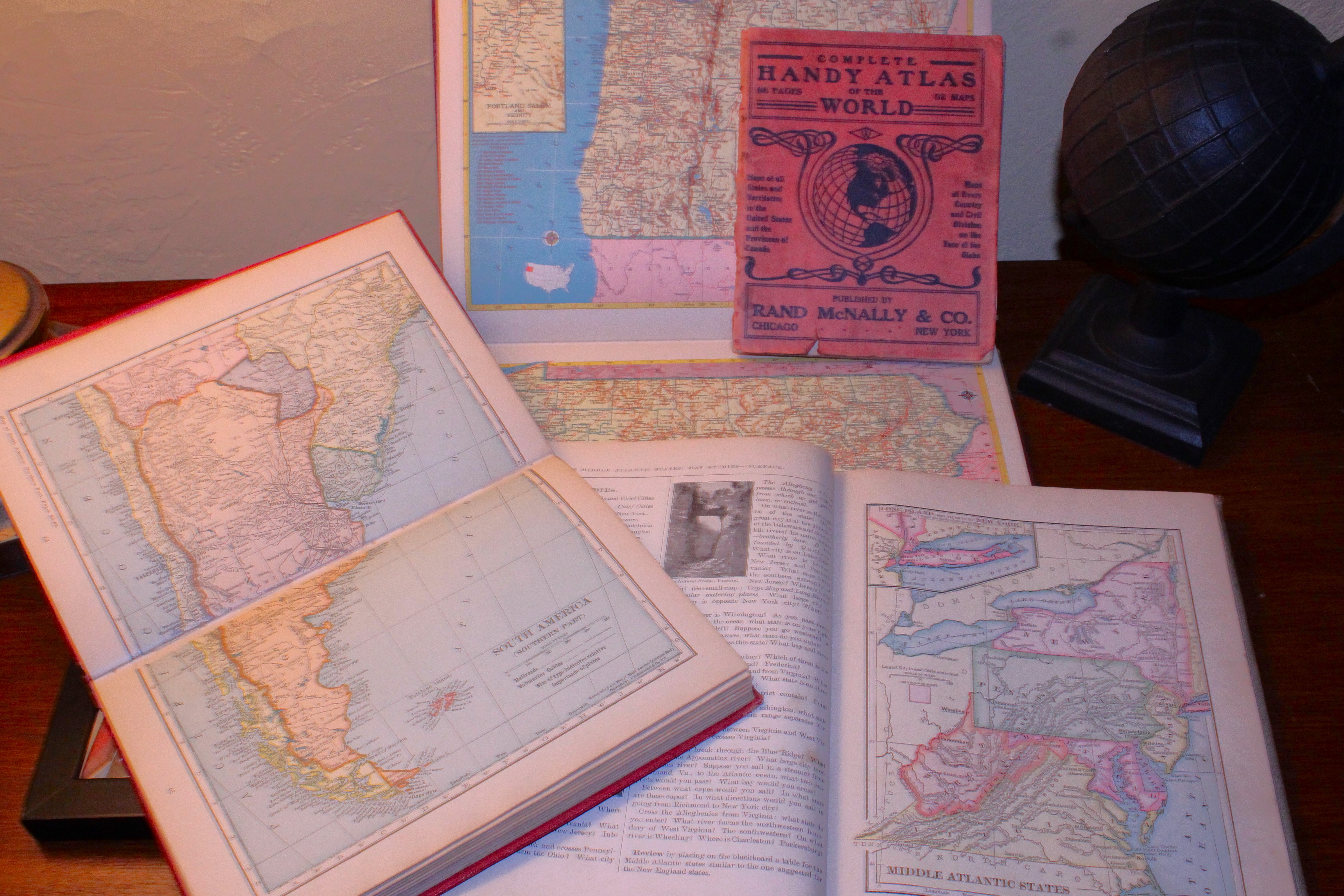
    My worn copy of a 1917 Complete Handy Atlas of the World is a small paperbound book that I found under a pile of magazines at a yard sale. It feels as if it has been used thousands of times throughout its life. Small and compact but still used a lot!

    In the back room I have a huge atlas; it is too big to fit on any of my shelves. Measuring 12” x 18” The Times Atlas of the World, Comprehensive Edition is also outdated. Printed in 1967, it is now a bit more than just a collection of maps and charts, it is also a collection of history! The populations of the countries have changed, as have the world’s inhabitants. The crops grown and the products manufactured are often different and many of the names of countries have changed. Due to the heftiness of this book you have to be a bit of an Atlas yourself to enjoy it!

    Well, enough about these, it’s time to get back to the dusting and organizing of my shelves, who knows what other atlases I might find in the process… today or in the future!


Saturday, October 7, 2023

Going to the Maps


I had just finished reading “The Cartographers” by Peng Shepard and was thinking about it. It was about maps and how they have the potential for making places real. While the book was about using a map as a key to entering a place no one else could go to unless they held the map, I’ve always thought that maps made things real to us. By showing us the way to go, we can experience places that we’ve only heard about.

    Every time I go on a trip, or even think about the possibility of going on one, I go to my maps. Atlas’s, gazetteers, simple folded gas station maps, (remember those?) and even the simple to use, internet maps, I use them all. Looking at them I can decide which routes to take, I can determine whether it will be a quick speedy journey or a scenic one. I can find places to stop and places where things can be found and uncovered. Maps are as important to me as my books are!

    I recently saw a picture of an old furnace that someone had posted. My curiosity piqued, I pulled out my reference materials.

    The first step was to check a book I have about iron furnaces. Published during the second half of the last century, A Guide to the Old Stone Blast Furnaces in Western Pennsylvania, written by Myron Sharp and William Thomas, has been invaluable to me, helping me find numerous old furnaces. Some were mere piles of rock, a few were empty fields or parking lots but there have also been a lot of exciting structures found. Some are hidden deep in the woods, inaccessible to anyone except those who don’t mind a bit of discomfort in their exploring. Some are sitting in plain sight beside the road. This book has taken me to numerous furnaces which while being over 100 years old, still show the mastery of the men who put them together!

    With a little more information about the furnace, I turned next to my Pennsylvania Gazetteer and tracked down the roads mentioned in the book. I also checked a couple other books I have to see if there was any mention of the furnace in them. I added more notes to my list and then I moved into the present century and the computer.

    I visited a favorite search site called Waymarking.com. They have a category called Iron Furnace Ruins which consists of seven pages of furnaces located around the world. I quickly found the furnace I was thinking about going to and clicked on it. I was presented a couple pictures and a GPS location! I copied them all. I put a mark on a map indicating where it was located.

    With Google Maps, I had a good idea of what the countryside looked like, the satellite view showed me near-by road marks, places which would help keep me on track.  On-line topographic maps helped me see what kind of hills and valleys I might encounter.

    I also searched the maps on Geocaching.com to see if there were any hides in the area. A new cache had been listed at a site that I had visited before, near another iron furnace. Located with-in 10 miles of the other, as the crow flies, I added it to the list also!

    I compared maps and made a route which would take us on a nice, scenic route, making sure to pass a few geocaches on the way. I avoided any toll roads and we would only take one expressway for about 5-10 miles. The ride would be an enjoyable one!

    On Thursday morning, I had my gear packed in the car and was enjoying a cup of coffee when Frank arrived. A bit earlier than planned but that was expected, neither of us has a problem with early starts. We hit the road well before the sun rose. Our first geocache was found with the aid of a flashlight. Soon after, the sky in the east started showing its colors.

    We made a brief photo stop at the Country Kitchen, its egg showing up nicely in the predawn light. A couple caches later, we hit route 80, just a little after 8. The slanting sunshine of the morning gave the trees even more color, making the ride a visual experience.

    We were getting closer, the Alleghany River had a slight covering of mist on it as we crossed it into Emlenton, then we headed back up out of the river valley to the hill tops.

    We found another cache less than a mile away from the furnace. Hidden on a small open grate bridge, it gave us another opportunity to get out and stretch our legs as we were looking. We signed the log and re-hid it and then drove another quarter mile where we encountered a gate. Parking here, we slung our camera gear over our shoulders and proceeded on foot. The trail was a gravel/ dirt road, going on a slight uphill slant before dropping down into the valley. Going down, we could see the road leveling off ahead of us and as we rounded a curve, our GPSs told us we had arrived.

    A slight rise in the surrounding weeds was all we could see, the sunlight coming from behind the furnace further hid the structure from us. We took a “path” which led towards where we thought it would be. As we pushed through waist high weeds and crossed over hidden fallen trees the stones of the structure started to appear to us.

    Surrounded by the weeds and bushes it was hard to get a whole view of the furnace. Vines grabbed at our feet and thorns tore at our clothes and skin. We couldn’t see where we were planting our feet, we could only guess and hope.


    Finally, there it was, the Webster Furnace. It was built back in 1838 and operated for an unknown amount of time. It went out of blast when the owners went bankrupt. What makes this furnace exciting is that the base is square like most furnaces, but the top portion has an octagonal shape covering the chimney, an eight-sided top!

    The furnace is in fairly good shape but trees have grown on top of it and their roots are slowly pushing the blocks apart, leading to its eventual demise. The underbrush made it difficult moving around it and seeing anything such as a mill race or walls, if there were any.

    After my photographic lust had been quenched, we packed up and started back up the hill. It was only seven tenths of a mile but it seemed to me to be further on the way up!

    We drove through the picturesque town of Franklin and stopped for two more caches before heading back towards home. The first was a failure; we couldn’t locate it and after a few minutes, continued on the final cache. Sometimes you’re lucky and sometimes, you just strike out…

    The second cache was great, in my opinion. We parked alongside the road and had to crawl over a deer fence. This put us at the top of a semi-deep valley. Most of the hillside was steep but there were a couple ramps which allowed access. Crossing a small stream, the furnace slowly revealed itself, sitting among the yellow fall leaves, hidden in plain sight.


    This was the Victory Furnace, built in 1843 and worked for about 7 years before it went out of blast. It is a nice tall furnace, the edges still sharp and square but it does have a few big cracks in it, one large one going up its front. I passed some cut rocks as I approached, possibly from the millrace or some other structures. There are supposedly ruins of the charcoal house on the hill behind it, I didn’t climb up to see but the idea of another trip has started to grow in my mind! Perhaps when the leaves have fallen and the sight lines are better.

    This wasn’t the first time I had visited the Victory Furnace. My first visit was because of another geocache. I stopped here early in the morning on a cool fall day in 2008. The valley was filled with fog and the sun was just rising, the area was dark, but that wasn’t going to stop me. It was a day that caused my imagination to wander.

    At the bottom of the hillside, I came to the stream. It had steep banks and I had to look around to find a place where I could get down to the water level. Splashing across the shallow stream, my GPS showed the cache only 50-60 feet away. Scrambling up the steep bank, the furnace revealed itself to me. Coming out of the fog, it resembled an ancient temple, much like in an Indiana Jones movie. With my heart beating and adrenalin pounding through my veins, I made my way through the fog and the weeds to the base of the furnace.

    Sitting alone in the valley, it appeared as if it had been dropped here. There were no roads or trails that I could see and no signs of any other ruins near-by. It was a mystical experience and the worst thing about it was that there was no one with me to share it with. It was one of those days that I’ll never forget!

    After spending some time finding the cache and taking pictures, Frank and I re-climbed the hill and returned to the car. In my mind, this was the best cache of the day! In another hour (or so) we were back at my house. Frank continued on to his home and I went in to change out of my dirty clothes and look for ticks. (none found!)

    I looked at my pictures and got a bite to eat and then sat down and started thinking…when could I go back to that last furnace?  

  I already have the maps…


Sunday, May 28, 2023

Maps on (In) the Mind

 Whenever there is the possibility of a trip approaching, I tend to go to my paper resources, my maps. Rather than allowing a computer to generate a route for me, I prefer to look over the area between the two basic points, the beginning and end, and then decide on a route myself. These directions are often determined by roads that I’ve never seen or driven on.

    What-ever prerequisites I have, a map is almost always employed. Many times it won’t even be a physical map but one of the many stored in my memory.

    Thinking about going from one known spot to another will bring to mind landmarks seen on previous trips. Things which have lodged in my memory, perhaps by their uniqueness, their photographic potential, their history or even geocaches which might be hidden near-by.

    Names of people and towns often slip through my grey matter like water between pebbles, here one minute and gone the next. I envy people with good memories. Thankfully, the maps in my mind have remained…so far.

    I picture maps as so much more than just paper directions. I see them in many of the things we do daily.

    The recipe for my Scalloped Potatoes is a map which takes me from the shelves in my pantry to the kitchen and finally to my dining room table. The readings at Church are maps that hopefully take me safely through the journey of my life, helping me avoid the wrong turns which are so easily taken. The discussions I have with my doctors and my banker are directions given, maps showing me the correct way to go. The plans we make are maps to our futures.

    I can’t help but think that the books I read are also maps. Time after time, they lead me to other books, places and activities. Many of the books I’ve read were originally mentioned in other books I had read.

    In the same case, I feel as if much of my reading is connected. I can’t count the number of times I read something; a place, an activity or a person and then read about it or them in another book I pick up. In some way or another, all the books I read have a connection, there is an invisible map that I occasionally see, but yet I am always looking for.

    When I mark down my chores at the beginning of the day which need completed, I am making a map for the day. My list of planned observations when I go out with my telescope is an atlas for my evening. My grocery list is a map; it is organized by how I will walk through the store. It becomes a set plan with minor deviations. I can picture where I’ll be walking in the store as I write down what I need. The list tends to shorten my visits; I wander less and minimize time searching, not to mention doing less “in the moment” buying.

    The objects we see in daily life can be maps also, directing us to spots in our memory banks. Looking at the Peonies in the garden in my front yard takes me on a short trip to the memories of my father who planted them 50 or 60 years ago. The Trillium plant in the back yard does the same thing. I open up my old Joy of Cooking cookbook and the stains, spots and wrinkled pages take me right to my mother, standing in front of the stove, her apron protecting her clothes, cooking meals for us. This is a book I’ll never get rid of, a map book to my feelings!

    The pictures I take are maps also. When viewed in order, they show the progress of our trips, reproducing the routes we took. Pictures, like books, can mean different things to different people; I can only hope that my pictures will take them to good places. Some pictures are made to make a point, they are maps made to bring people to a certain realization. We (the photographers) keep our fingers crossed that they will arrive at the place we wanted to take them!

    Maps, like pictures can pull us into the past, showing us what once was, helping us to remember the ways things used to be. Old maps can be helpful in finding places where things have disappeared. I use maps to find the ruins of old buildings, ones that were torn down decades ago. Those old pieces of paper, worn at the creases, direct me to where mills once stood, producing iron for a growing nation, or to where canals used to be, ferrying passengers and produce across the states. With their help I can envision what used to stand in the empty fields I find.

    As I was thinking about writing this, I wrote down some notes. Thinking about it, they are a map also. I made them to help me write this. Hopefully that map will get me to my final destination! (the next and last paragraph)

    Our world is filled with maps that we see daily but fail to realize that they are there, helping us in our daily lives. Modern technology has provided us all with maps, as close as our phones. Even if they are spoken, (“Turn left at the next intersection in 100 yards…”) they are still maps.

 Maps, I can’t help but see them everywhere!


Sunday, April 9, 2023

Searchin'

 Thinking about all the things that can be found in near-by areas, I came up with quite a list. The amount of “cool finds” is limited only by your own imagination.

    In our travels, we have discovered old ruins where houses used to stand along with barns and sheds barely standing. Old abandoned bridges crossing streams and rivers, ghost signs barely perceptible on the walls of buildings and stores and shops, abandoned to the elements. We’ve found religious statues covered in dirt and vines, forgotten in the backyards of empty churches. We’ve searched out and found piles of rocks which once were used as furnaces to make iron.

    Our geocaching adventures have taken us to fantastic views from the tops of cliffs and have brought us to hidden waterfalls deep in forest valleys. We once came to a spot where an airplane had crash landed and not far away was an old mill stone quarry, the stones laying in piles, some half finished, all covered with leaves, small saplings and weeds. We’ve found old cars and even trolleys sitting in the woods. Huge limestone mines and tunnels, no longer used except by explorers and graffiti artists.

    There are so many things hidden in the hills and woods and alongside the roads of the tri-state area. All you have to do is go out and look for them.

    We’ve stopped to look at old construction equipment, rusting away beside the road. I’ve photographed old tractors with trees growing through their frames, farmhouses made of logs and collapsing with the weight of time, good for nothing except a person with a camera. We never know what we might come across.

    This past Friday, Ann Marie and I took another trip. We headed to the west towards Weirton, West Virginia. There were a few geocaches I had in mind to look for and there were also ruins of old steel mills that might be photogenic. I also had the general location of an old iron furnace that we’d try to find. Anything else we came across would be an added bonus.

    The day was loosely planned, our route was open to change, it all depended on what we came across. Weirton isn’t far from Pittsburgh, less than an hour drive. We entered the town shortly after 9. Our first stop was at a restaurant where we got some breakfast. Specializing in biscuits, we both had breakfast sandwiches. Properly fueled, we headed towards our first geocache.

    The Veterans Memorial Bridge was opened in 1990. It is like no other bridge in the surrounding area. Suspended by cables strung from a high center tower, it was the third bridge of this type in the world when it was built! The cache was very close to it. We needed to find some numbers and they would tell us where the cache was hidden.

    We walked up a gravel road and found the numbers we needed written on the back side of a guard rail. A walk of about a ¼ mile brought us to the end of the Veterans Bridge. The cache was hidden about 10 yards away from the bridge, a view that very few of the drivers crossing the bridge ever see. 

    We returned to the car happy, we got some fresh air, a nice walk and a successful find. We then headed towards the northern end of town to see what was left of the old steel mills. Sadly, most of the buildings were gone, torn down leaving only a few unremarkable buildings, lots of pipes and wide empty fields.

    We were driving on Main Street but it didn’t look like one. Open empty lots were on one side with a wall and fences on the other. The buildings were all gone, only a couple houses remained, it was mostly scrubby lots alongside a dirty brick road. There was hardly anything that showed how industrious this area used to be. Closer to the center of town the mills are still in operation but here it is another story.

    Driving up the hill we came to another cache. Hidden on a hillside covered with weeds and jagger bushes, I scrambled up to where I found some partially covered cement steps and some yellow brick walls. This spot was once someone’s front yard. The brick walls lined their sidewalk, now they were slanted and falling down, their only purpose now was to hide a geocache. 

    Not far away was another remnant of the mills, some sort of tower. The temptation to climb it was strong but I managed to resist it!

    A short drive then took us to the Peter Tarr Furnace. Built in the late 1700’s and working until 1815, all that’s left is the stack. Finding it wasn’t as tough as we imagined. It was sitting right beside the road, looking sort of like a decoration for the housing plan beside it. Reading up on it, we found out it has been rebuilt twice. What makes it interesting is that it is round as compared to the normal (?) square pyramid shaped furnaces. 

    We were a bit disappointed when we found it; it is built around a steel corrugated pipe and held together with modern cement. The “neatness” of it sort of takes away from the historic aspect of the location.

    We’ve found piles of stones hidden by trees and weeds, stones which once were a point in history. I would feel excited after finding them, feeling as if I was the first one to find them. Perhaps I was, the first in a year or two or maybe even decades. This furnace posed no problems, its neat shape was sitting right beside the road, we rounded the curve and there it was.

    We were still happy finding it; it was another furnace to add to our list!

    Crossing the Ohio River and entering Ohio, we headed north into East Liverpool. We drove around the town looking for a spot to get some coffee and some lunch. We saw lots of ghost signs and plenty of nice buildings, built in a time where decorations were commonly added. Nice decorative woodwork over the windows and doors and inset balconies set in between windows adorned many of them. Victorian types of gingerbread and cupolas, it was enjoyable driving around the town. 

    While driving along a brick street below a highway I caught a glimpse of something behind an old, bedraggled building, it looked like a furnace. Luckily, the traffic was nonexistent, and we were able to back up to see what we nearly missed. It was a large bottle kiln sitting behind the building. Used in the pottery industry these kilns, named after their shape, were commonplace in the town. 


    Trying to find more information about them, I found that they tended to be rather dangerous. Fires were often started resulting in factories burning down. We explored around it and the building, took a few pictures and then headed across the river, back into West Virginia.

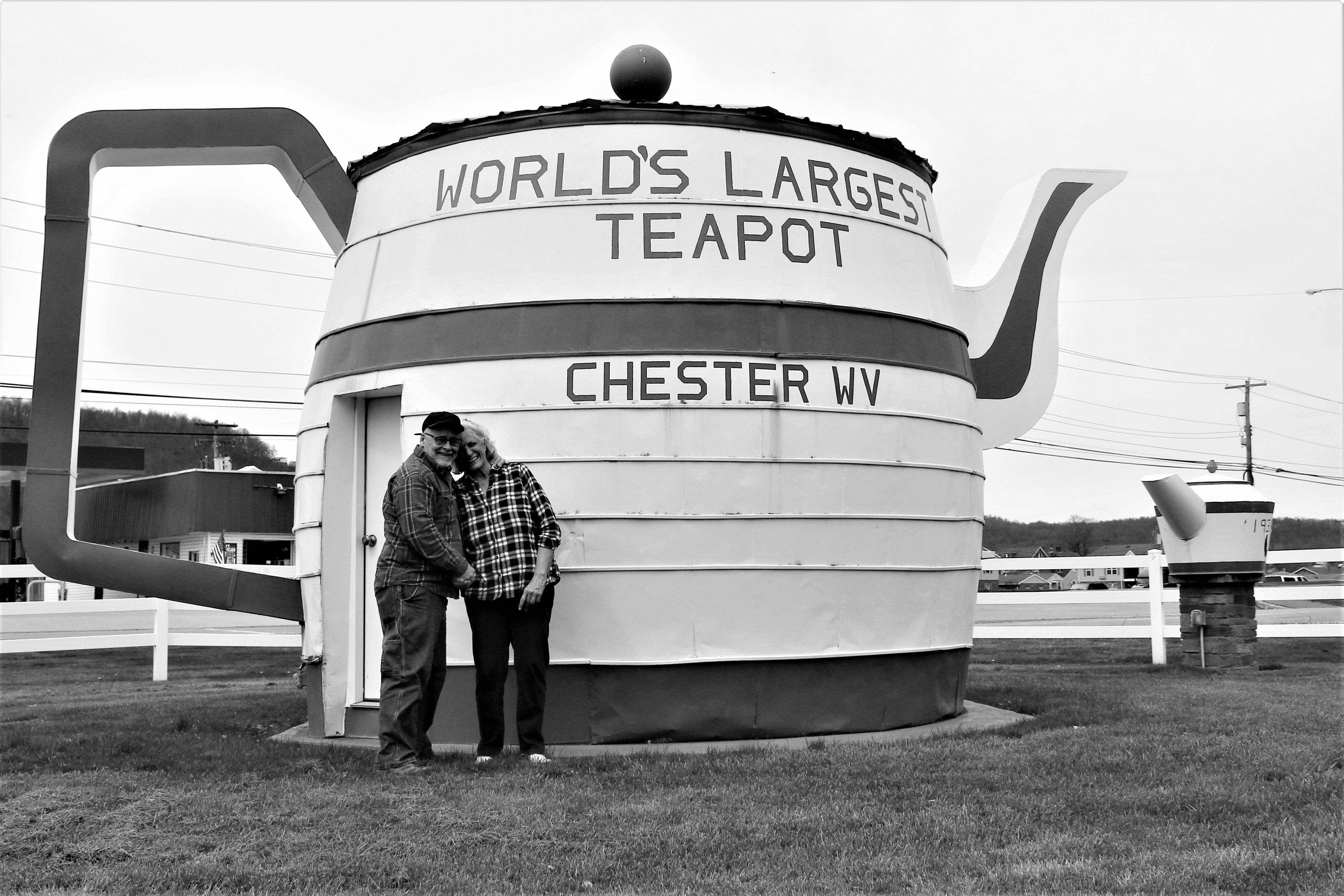
    A quick stop at “The Largest Teapot in the World” for a snapshot (Hmmm, have they ever been in Bedford??) and then we headed towards Pennsylvania and home.

    Four caches searched for and four found, 100%, can’t complain about that! We found the furnace we were looking for, even though it wasn’t as exciting as we had hoped. We also found a pottery kiln that we weren’t expecting. We saw nice views of bridges and the Ohio River and enjoyed exploring the river towns we passed through on a nice day. It turned out to be a great trip!

    Why do we search for these things? Is it our curiosity, our yearning to learn more about our history or just the enjoyment of being out on the road together, enjoying each other’s company? Perhaps it is all of these things! There is so much more out there waiting to be found and seen and we will keep looking for them as long as we are able. It is fun and exciting following the impromptu maps in our heads and finding out where they lead us!

    (I just saw an article about another iron furnace we haven’t seen yet in Clearfield County. Hmmmm…could be another road trip in the near future!)


Thursday, March 30, 2023

Gotta Map?

During some of my recent bookstore visits, I picked up a couple books worth mentioning. Both were purchased at City Books on Pittsburgh’s North Side and both of the books have to do with maps.

    The first is a nearly new book (2018) called The Writer’s Map. It contains a group of articles by twenty-four different authors. These essays or chapters are about how maps are often included in books and can also be influential in the first thoughts of a new book or story.

    The illustrations in this larger format book are very nicely copied, having maps of both real and imaginary places. All of them were made to help us find our way, whether through the real world or the book we are reading.

    I always enjoy having a map included on the inside cover of a book, (This book has one!) I refer to them frequently and am disappointed when they aren’t a good representation of the novel. These maps make the location of a story that much more real to me. It helps me to envision the place!

    The second book is an old Collier’s World Atlas and Gazetteer. Printed in 1935, it has the ability to take me back into the past.

    Back to when Alaska and Hawaii weren’t states yet, back to a time when the city of Pittsburgh was covered with railroads. I find it fun to browse through the maps and see what has changed over the past eighty-eight years. There are countries, and neighborhoods in this atlas which no longer exist and lots of places which have been absorbed by others. The statistics have changed a bit also. 

    There are a couple older atlases and maps in my collection which show Pittsburgh being spelled without the "h" at its end, (pre-1911) and where West Virginia hasn’t yet divided from Virginia because of different thoughts dealing with slavery. (Pre-1863) Looking at old maps can be another form of time travel.

    I find maps absolutely fascinating, whether they are the old crinkly maps, printed on tissue thin paper in the Beadeker Travel Guides, old folded gas station maps or star maps printed on thick paper in the Uranometria volumes. I have a couple atlases of the human body, filled with color plates showing the bones and what muscles are used to power them along with maps of the veins and arteries that fuel them.  Pictures of the human body, but they are maps never the less. In novels, my opinion of a book rises if it contains a map, or even better, a few maps! Maps such as; the Treasure Island map on the inside covers of the book, Swiss Family Robinson’s map, the map of Steinbeck’s Travels with Charley or the jungle maps of The Lost City of Z. They all guide us through the book. What a wonderful accompaniment!

    While reading The Writer’s Map, one of the chapters was written by Reif Larson who wrote The Selected Works of T.S. Spivet. Some of the maps in this book are included and after reading that chapter, I went to the bookshelf and pulled my copy of the book out and started re-reading it. As of right now, I’m about 60 pages into it. What a great book!  (It is about a young, (very young!) cartographer who is invited to make a speech at the Smithsonian Museum. They have no idea how old he is. He sets off on his own, going from Montana to Washington DC, mapping his journey in his journals. I’ve re-read it a few times and enjoyed it every time.)

    The fact that I started re-reading this book once again is an example of how I believe that all books are connected in some way. Books I am reading often have a similar plot, the same location or the same subject matter as the one I just completed. This doesn’t happen all the time but it occurs enough that I look forward to seeing what similarities the book I’m reading might have with those of the past. This example also shows how one book can lead me to another. In a way…it was a map to the book that was sitting on my shelf.

    A quote from another book I just read, The Lost Continent by Bill Bryson fits right in here. Writing about his father; “there was almost nothing he would’ve liked better than to cover the dining room table with maps and consider at length, possible routings

Maps, where would we be without them?   I know I’d be lost!


Monday, May 18, 2020

My Library

 
Spending time at home during this period of self quarantine, masks and social distancing, I have been doing a lot of reading. In fact rather than doing the jobs that need done around the house, I tend to find myself getting lost in other worlds, the various worlds inside my books.
                I have been doing a lot of reading on my Kindle. This is mostly because of the ease of getting new books. Unfortunately, the Kindle does not fulfill all of my personal reading requirements. I have a need, a desire, a craving for books that are printed on paper. Hard backs with nice covers or paperbacks with the pages bent from previous readings. I was just thinking yesterday as I read my Kindle, that I never lost my place in a printed book by accidentally swiping my finger across the page! In these trying times, Kindles can easily get on my nerves!
                Call me old fashioned, or afraid of technology, for that matter, call me anything you want. I know what I am. I am a bibliophile! I love books. I love the feel, the smell and the heft of a book.  To be able to page through it and stop at spots that interest me is important, especially when looking to buy a book! I like that I can see how far I’ve progressed by the location of my book mark. I don’t need to rely on a sliding bar or a percentage listed at the bottom of the page.
                Because of this love, I have a nice collection of books that I enjoyed reading. Being a firm believer of libraries, I make use of their marvelous collections and when I find a really good book, I’ll look to buy myself a copy. I pick up a lot of books at estate and garage sales. Bookstores also add a lot of books to my collection.
                The vast majority of my collection are pre-owned editions. They far outnumber my newly purchased books. Needless to say, there are a lot of books in my home. Some of them have been with me for over 6 decades. There are a lot of them that are older than I am, having been printed a half century or more before I arrived on this planet.
                A friend and I were discussing the order we keep our books in. He was thinking about making a list of all his books.  I don’t have a list but I can usually find a book I need within a minute or two. They are ordered in a semi-organized way.
                Let me take you on a brief tour of what I call my Personal Library. Like most libraries there is an assortment of both fiction and non-fiction. I believe the non-fiction slightly outnumbers the fiction in the collection. There is also more than one room in my library, the books are distributed around the house.
                We’ll take a look at what I like to call the reading room. There is a large table sitting in front of two windows giving me a view of the woods behind the house. They also provide light for reading during the daylight hours. The table is large enough to hold my laptop or typewriter and still have lots of space for reference materials.  The table also comes in handy when I am matting or framing pictures. Every library needs a big table.
                Sitting at the table, to the left are shelves filled with books on Pittsburgh and Pennsylvania. The subjects are varied, from early iron furnaces, canals, railroads, atlas’s, travelogues to architecture and sculptures.  Beside this set of shelves is one filled with reference books. Dictionaries, (I love dictionaries!) Thesaurus’s, books on quotations, birds, word origins and other subjects that might help me properly state something or to help me understand things.
                Unlike most of the books in the collection, I can honestly say that none of the books on this shelf has been read through, cover to cover. Almost all of them have been used, many of them numerous times!
                On the other side of the room is a set of shelves holding books about writing. Below them are books on Machining, both old and new. I have books about machinery powered by belts up to modern manufacturing procedures. Below that is a shelf filled with assorted papers I wrote and photos I took. The majority of these will never be seen by anyone but me. (That and the person who cleans it all up after I pass on to the great library in the sky) Looking at these piles I think that one of the sad things about computers is that the things I write now, are hardly ever printed. It is all saved on a hard drive and memory sticks, susceptible to being wiped out or lost at any time.
                Below this shelf are a couple boxes of photographs waiting to be framed.  Beside them are an assortment of old school books and instruction manuals. From steam locomotive upkeep to geography and mathematics, they are old and interesting to page through. I love to see how things used to be and how some things never change!
                Beside this shelf is a smaller one containing mostly poetry.  These shelves I’m happy to say, are all in alphabetical order by authors name.  I can’t say that about any of the others!
                Behind me is another shelf which has on top of it, one of my “To read” piles. The height of the pile varies but recently it has been dropping since no new books are coming in. Whenever I finish a book from one of these piles, it gets put on a proper shelf or in a box for donation to a library for their book sales.
                The top shelf has books on architecture and archeology with a few books on exploring tossed in. Below them are books on maps and books that have maps in them. ( Treasure Island for example ) There are also a collection of atlas’s covering the earth, space and even the human body. Some writing materials for letters and cards populate the shelf below along with some overflow books. Below them are some oversized books.
               This is just one room. Books on books, travel, astronomy, religion, camping, hiking, cooking and fiction are spread out though other rooms.  There is a shelf of signed books and a collection of my first blog. (The only printed copy! Oh, this will be worth a fortune some day!  HA)
                The room I described to you is just a part of my library. As you can see, I live in my library! My love of books could be considered by some as an excess, but as any bibliophile knows, there can never be too many!
                I do periodically clean out the collection, passing the unwanted or unneeded volumes on to a library for them to re-sell during their book sales. I am anxiously waiting for the re-opening of the libraries and bookstores. I am not a big fan of on-line book shopping, too much of my buying experience involves touch and browsing. The act of browsing is exciting, I never know what might show up. I never know when that special book will jump out into my hands!
                We just went from Red to Yellow conditions here in Alleghany County. I’ve got my fingers crossed that some of the bookstores will be re-opening. I have a strong desire to acquire some new books!
                In the meanwhile, I have recently started a new book. It is a hardback with a nice cover, titled "The Years Best Fantasy and Horror". (from 1995) Hopefully this should keep me occupied for a couple days.

                Oh yeah, I almost forget about those chores that need done…


Thursday, April 30, 2020

Biblio-Trip


Biblio-Trip

August 2018
                I often wonder about this disease I have. It is an almost uncontrollable desire for books. It is a passion. It is a habit that I haven’t been able to break. It is an addiction. I just need my reading material.

                Books about Pittsburgh and Pennsylvania. Books dealing with machinery and machining. Maps, atlases, astronomy, writing and poetry to name just a few of my interests. Then there are the fiction books…

                I am always on the lookout for another book to add to my collection. Older books, ones signed by their authors, there are so many subjects that interest me! Lately I have been going to estate sales which expose me to shelves full of books. Usually they are “best sellers”, worn children’s books and lots of religious material. But…every so often I find a book that strikes a chord.

               Book sellers get to these sales early and have pillaged the shelves before I get there. They aren’t collectors, these books will be on-line the next day. This makes it even more fun when I find a book I want!

                The fun of the hunt along with the low prices are a couple of the things which drive me. There are so many books I’ve heard about, read the reviews on but just haven’t gotten to read yet. Finding one of these can be breath taking! Well, kind of.

                Last Saturday, Ann Marie and I took a road trip to the outskirts of Carlisle, PA. to visit Canaday’s Book Barn.  We have visited it a few times before. Unfortunately, it will soon be closing. We were both extremely sad to hear about its approaching demise. The store is truly unique, it is located inside a barn. We had to visit it one more time before it’s gone forever, plus, they were having a big sale!

                You would never know what is inside if you didn’t read the sign beside the door. The barn is typical of the farm buildings in the eastern sections of Pennsylvania. Constructed of yellow painted wood and stone, it is topped with a red metal roof making it a very picturesque building. The front, facing the main road, gives no hint to its purpose except for a small sandwich board sitting in the yard. In the back is a gravel parking lot and the entrance.
             The door is in an alcove in the center of the building. Walking inside, you are greeted with shelves. In front of you, an isleway continues into the distance. On the right a beautiful glass covered set of shelves holds books on display along with artwork and maps. To the left are more shelves, all filled with books. All are nice and clean, no dust, no cobwebs. A balcony sits off to the right, the stairs are rough but varnished and polished, like the rest of the woodwork in the building. Under the balcony is an open office and the checkout counter. More shelves share this low, dim area along with a couch. The wooden beams give it a comfortable look, similar to a den. There are a couple sets of thin drawers beside the shelves populating this area. In them are more maps and hand colored drawings and illustrations. Some are already matted, ready to be framed and hung on your walls.
                At one time, the shelves in this room were decorated with world globes and bookends and the rear wall was covered with framed pictures. These have since gone on to new homes. For the most part, the shelves are all fine quality, looking as if they once graced a prestigious library. Nicer books are kept behind glass, the rest sit on shelf after shelf.
                Entering the store for the first time can be a bit overwhelming. You have no idea which way to turn, where to look first. It is best to just slowly walk around and familiarize yourself. Let your fingers run along the shelves, read the titles, absorb the ambiance, smell the old book smell. Enjoy yourself, soak in the wonder of all these books. After you have walked around a bit, once you have an idea of where things are located, go back and re-find the treasures you saw as you were orientating yourself.
                Ted, the owner is a very personable man. If he isn’t overwhelmed with customers, he is happy to talk books or local history. Since he is selling his stock at 70% off, his customers have increased. Too bad they didn’t frequent the store before he decided to close. Even though Ted was busy, we still had a nice discussion with him. Oh, just thinking about this store closing makes me sad, this delightful store should be visited by every bibliophile!
                Wandering around the store, I picked up a few books I had seen on previous visits. Yes, I brought them home with me this time. I bought a few autographed books, some old machining manuals, a couple travelogues and a random assortment of other books which caught my eye.
                   I had three topographical maps from the early 1900’s in my selections but when I saw my final total, I reluctantly put them back. Naturally, not long after we left, I started wishing that I would’ve bought them. “Oh, when will I ever learn? Get when the getting is good!” 
                The two of us returned with a nice collection of booty and we agreed that the trip was both fun and successful. There is nothing like a road trip to a bookstore!
                I originally thought that we would be gone for only seven or eight hours but the sun was setting behind the hills of Etna as we rolled back into town. I rarely take a direct route to any place we are going to. Our journeys usually involve “short” side trips, refreshment breaks and photo stops. On this trip, we also ended up spending a couple hours inside the bookstore.
                It was about 11 hours and 380 miles after I left home that I pulled up in front of my house. I was excited about looking through my new purchases and more than ready to collapse into my bed!
                Yes, my addiction had gotten the best of me once again. I bought too many books, but you know what? Other than the fact that I left the topo maps behind, I really don’t regret it at all!
(I went back a couple weeks later with a couple friends and purchased the maps among other things!)
 
                                Bibliophile-         n.            a lover of books
                                                                                A book collector
                                `Biblio-trip           v.            a journey or voyage to aquire books

Adventure is Where You Find it!

The day was done. I had spent a fair amount of it working in the yard and as far as I was concerned, it was time to relax.      Sitting do...