Showing posts with label stars. Show all posts

Wednesday, July 23, 2025

Sounds of the Night


Sitting on the front porch with my head tipped up towards the sky, I breathe in the cool air. The sun has set and the sky has darkened. After a warm day filled with chores it feels good to sit and relax, to look up at the bright orange star Arcturus and a few stars of the Big Dipper’s handle. The trees are silhouetted by the brightness of the dark sky, a bit of an oxymoron but yet still true here in my suburban neighborhood. My chair is positioned so that it blocks the bright light on my neighbor's front porch but still my yard is illuminated by its glare.

    I had made the mistake of looking over at it when I came outside and I still am seeing a dark blob as I look up at the sky, it's getting better, and I figured in a few minutes my eyesight will be back to normal. Slowly the dark patch shrunk, and more stars appeared.

    A train had just passed below the house. The heavy sounds of the engines preceded the loud, piercing blare of its whistle. Passing behind hills and around the curves of the valley, the noise of the engines was soon lost with only the clanking and squealing of the cars behind. Soon that was also lost as the train moved north. Quiet, if you want to call it that, had returned.

    Fireflies flickered in the evening’s darkness and a few more stars appeared.

    Cars can be heard on the highway, muffled by the distance yet magnified by the silence. Tires whining and building in volume denote trucks, and like the train, are soon lost as they follow the roadway. Above, an airplane splits the darkness of the sky with its flashing lights and a little after, splits the quiet with the noise of its jets.


    A bright spot appears in the western sky, slowly drifting towards the end of the Dipper’s handle. It is the Chinese space station, Taingong. Approximately 250 miles above me it passes without a sound. I turn to watch it drift into the east and am hit once again by my neighbor’s light. Blinded I get up and move to a shadowed spot where I can see the station as it moves past Vega and then through Cygnus. It slips behind the trees and is lost to me. Mentally I wave good-bye to the six astronauts on board, “Until the next time!”

    Sitting back in my chair I look up at the stars again. Nothing is moving but yet, everything above is in motion. Their distance hides the movements from my mere mortal eyes. Watching further, fireflies flicker, adding some perceptible motion to the canvas above me.

    I sit and remember other times I’ve sat under the night sky. The sounds came back; crickets and cicadas in the spring, deer creeping past and snorting when they see me, the howls of coyotes off in the distance, their pups yipping along with their parents. The sounds of a near-by stream as it gurgles in the darkness, a few yards from my tent, soothing me before I bed down. The sound of the snow softly falling on a cold winter night, accompanied by the crunching of each footstep I take. These are some of the many sounds that make you feel one with nature.

    The noise of the cars and trucks on the road has faded into the background, for the most part un-noticed now. The cool air feels good against my bare arms. Somewhere behind me an airplane’s engines announces its presence; I don’t bother turning around to look. Arcturus has slowly drifted closer to the dark tops of the trees and when I look back again, it has dropped behind them, hiding from my gaze. A car door slams and a horn toots as the car doors lock. I can hear my bed calling to me, quietly but yet still noticeably. I ignore it and continue looking up, thinking about the day gone by and about the new day ahead. The night here is far from quiet, but at the same time, it can be so soothing and peaceful!


Thursday, March 21, 2024

The Lure of the Atlas

 When contemplating a trip, I always go to “my maps”. They come in many shapes, sizes and styles. During a recent attempt to bring a bit more organization to my bookshelves, I came across the shelves dealing with maps; books about maps, books which incorporate them in their story lines and books with maps on their pages and on their covers. There were also a group of atlases.

    Atlas, Greek Mythology says that he was a Titan who was punished by the gods for fighting against them. His punishment was to stand on the western edge of the world and hold the weight of the heavens on his shoulders. Along with being a strong man he was also wise and is considered in some texts as the “founder” of astronomy.

    His name became synonymous as a collection of maps or charts after the publication of a book of maps in 1595, made by Geradus Mercator. Published after his death, the volume had a picture of Atlas on it and before long the name atlas became a term to identify a bound collection of maps, books which help us navigate and understand our world. Mercator was important in the map game also, but that story will have to wait until another day.

    Looking around my shelves, I realized that I have quite a collection of atlases. I have some made for children, there are some older ones, (though not really worth much except to me) a few historic reproductions, there are atlases of the stars and even a couple that are atlases of the human body. How is it possible for a person who loves maps, not to have at least one (or two) atlases?

    In my car is an old worn Delorme Atlas and Gazetteer of Pennsylvania. It is over 15 years old, notes are scribbled on its edges and places we’ve visited are circled. A few routes are highlighted. The pages are falling out of it yet I still keep it close at hand.

    I love my Gazetteers, I have a variety of them for the surrounding states. Along with the one in the car, I have two other Pennsylvania Gazetteers, one for the upstairs and one for the downstairs. They are in much better shape than the one in the car and, yes, I use them both frequently! The gazetteer I have of Alaska isn’t used that much but every once in a while…I get it out to just page through it and daydream.

    There are a couple other atlases in my car, one of Pittsburgh and one of the United States. Being a map fiend, dare I say “mapaholic”, there is also a collection of folded paper maps in the pocket behind the passenger seat.

    GPS, no, I rarely use one for driving, only for geocaching. The paper maps work just fine! But, in essence, the GPS is an atlas also. It is a collection of maps which help us through our world. I don’t often use a GPS to help me with my driving but I do use another internet service, Google Maps. I often use this to see where the various turns I need to make are. Using the satellite view I can see what my turns will look like, what buildings or businesses are near-by. Using the street view gives me an idea of what I’ll be seeing before I need to make the turn. I can pick out landmarks to help me prepare for what’s ahead. This isn’t full proof, as this Thursday’s trip proved. (inside joke!)

    Going out to observe the night’s sky, I will pull out some of my star atlases.  Using these helps me to plan the night’s activities, giving me an idea of what’s visible in the sky that night. Whenever a comet is visible in our skies, or if one has just been discovered I will drag out the sky charts to see where it is. To name a couple of the volumes I have, there is the children’s book The Stars, by H.A. Ray, an atlas made with simple sketches. There is also Norton’s Star Atlas and Reference Handbook that I have been using since I first got involved with astronomy. A Bright Star Atlas by Terion and Skiff helps out when I need some quick and easy charts and the Uranametria for when I need a bit more detail.


    Once again, in our modern times, this can be done on your computer or cell phone but I still like seeing it on paper. Pointing your phone at the sky doesn’t help you become familiar with the constellations and stars, to me, it’s just a nice shortcut. I often add notes and dates for various things I’ve seen, marring my books but adding a bit of history to them.

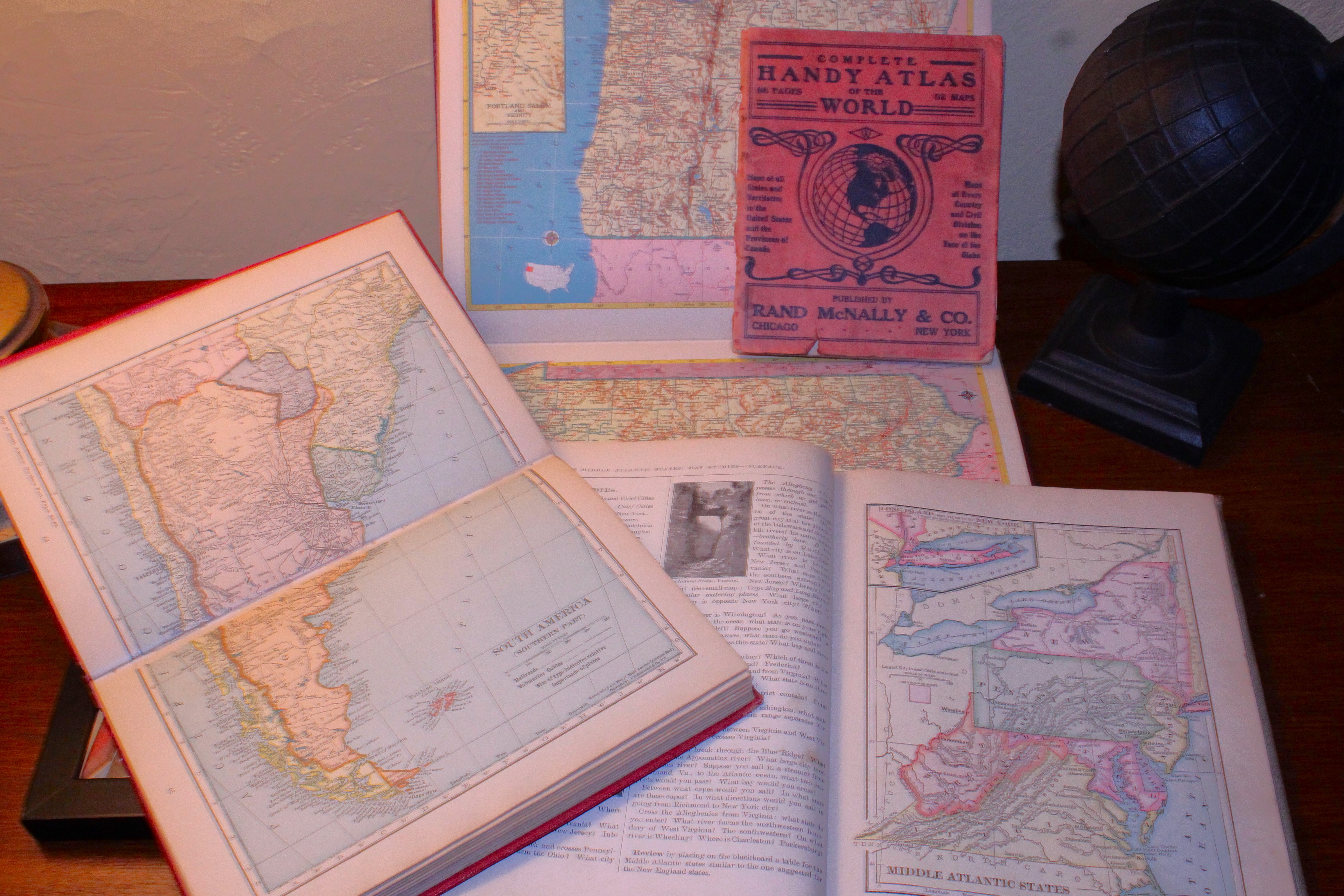
    I have some older atlases including a 1927 Literary Digest, Atlas of the World and Gazetteer. It is filled with hard to read maps with city names squeezed into the states and countries. Using this to get from here to there would be next to impossible!  A Maury’s New Elements Geography (Pennsylvania Edition) from 1913 is fun to read. Published as a geography book it can still be used as an atlas. Along with the maps of the world and the U.S. states, it is filled with information about the various countries and states. Granted, the facts are a bit out of date but that is one of the things which make it fun to browse through. 

    My worn copy of a 1917 Complete Handy Atlas of the World is a small paperbound book that I found under a pile of magazines at a yard sale. It feels as if it has been used thousands of times throughout its life. Small and compact but still used a lot!

    In the back room I have a huge atlas; it is too big to fit on any of my shelves. Measuring 12” x 18” The Times Atlas of the World, Comprehensive Edition is also outdated. Printed in 1967, it is now a bit more than just a collection of maps and charts, it is also a collection of history! The populations of the countries have changed, as have the world’s inhabitants. The crops grown and the products manufactured are often different and many of the names of countries have changed. Due to the heftiness of this book you have to be a bit of an Atlas yourself to enjoy it!

    Well, enough about these, it’s time to get back to the dusting and organizing of my shelves, who knows what other atlases I might find in the process… today or in the future!


Saturday, June 11, 2022

Welcome to the Star Party

 Welcome to a night under the stars. If this is your first time visiting a star party, here are a few guidelines.

    Star parties are held to allow the general public access to the telescopes owned by astronomy clubs and astronomers. The goal is to introduce you to the night sky and astronomy. On a good night you can expect to see double stars, galaxies and nebulas along with the moon, planets and satellites. Every time you visit one, different things can be seen.

    The telescopes are set up there for you to observe through. All you need to do to look through these instruments is to ask! These are often very expensive, be careful when looking through them and follow the owners instructions. Don’t touch the optics or move the scopes. If you want to look at something else, ask and if possible, the owner will show you.

    They will tell you what you are looking at and hopefully be able to answer any questions you might have. If they don’t know the answer, chances are that someone else near-by will!

    Weather plays a big part in star parties. If there are clouds in the sky, chances are the telescopes won’t be set up. Heavy clouds hamper viewing and the members don’t want any moisture getting onto the optics. So saying, rain will cancel these events. If the weather looks threatening, call the observatory before driving up!

(Observatory phone #’s are usually on the clubs web site)

    If you have a telescope at home, bring it along. Most star parties have darker skies than those closer to the cities; this will enable you to see more than you normally do. If you’ve never used your telescope before, come up early, while the sky is still light, and someone will be able to help you set it up and explain how it works. If you have a pair of binoculars, bring them along also. You will be surprised at how many stars you can see through ordinary field glasses. Bring a lawn chair if you want, to just sit and enjoy the skies above.

    If you are considering buying a telescope, a star party is a great place to see what is available. Compare the views you get through different styles and brands, ask the owners what they like about their scopes and what they would recommend.

    Bringing a jacket and a hat and wearing long pants is suggested since the temperature quickly drops after sunset. Most star parties are held on hilltops and there is usually a slight breeze blowing!

    There is no smoking or alcoholic beverages allowed near the telescopes and it’s best to leave your pets at home to avoid any problems.

    Another important thing is, don’t bring a flashlight! Bright lights are frowned upon at star parties. If you don’t know how to dim your cars lights, please park near the entrance and walk up to the site, it’s won’t be far! This will preserve everyone’s night vision.

    After being in the dark for awhile, your eyes become accustomed to the dim light. Your pupils open up to permit more light in, allowing you to see more. Just a brief glimpse from a white flashlight or a car headlight will cause your pupils to shrink. It will then take up to 20 minutes for you to regain the night vision you had before. Astronomers use red flashlights since this won’t cause your pupils to react.

    Children are very welcome at star parties; we hope to instill the love of astronomy in them at an early age! Keep your children close at hand. Explain to them about how costly these instruments are and share the need to respect the equipment and the owners.

    When you go on trips, check to see if there are any astronomy clubs in the areas you will be visiting. They will usually have the dates of star parties they have planned on their web sites. Major parks have star parties also, their skies are often much darker than what you experience normally and they want to share this with you. Check before you visit. Commonly, star parties are held during the summer months and whenever something special happens, such as eclipses or meteor showers. Keep an eye out for them and come up and visit!

    Should you be bitten by the astronomy bug, members will be more than happy to tell you how you can join the club, anyone is welcome to join! You don’t need any expensive equipment, just your enthusiasm!

    To find out more about the Pittsburgh club, the AAAP, their two observatories and their star party schedule, visit;

http://3AP.Org

    The night sky is a treasure which is often over looked; a visit to a star party just might help you see what great things you’ve been missing! Chances are, I'll be there and I’ll be watching for you! Be sure to say "hi"!


Friday, February 25, 2022

Going Old School

     We as a society have a tendency to jump into any new type of advancement that shows up. We are always being tempted with new ways to communicate, to share our opinions and our art.

    The old methods often lose their appeal and some just die off and disappear. A lot of these “older” systems are still around and are being used but their permeability is always suspect.

    Phones are a wonderful example. Going back in time, the people of a town used to rely on a telegraph operator, someone knowledgeable in deciphering Morse Code. Before that, the quickest means of communication was by a rider on a horse. Then along came the phone lines.

    Both the mail service and the telegraph services are still being used. Delivery by riders on horses has pretty much disappeared and Morse Code is used mostly by amateur radio operators. You have to admit, it is pretty rare when anyone gets a telegram.

    Phones once held a special place in our homes; some houses even had a special niche where it could be placed. The number of land lines has slowly diminished, now days; nearly everyone has a smart phone. We can be called at anytime, available whenever anyone wants us. This is the way of today’s world!

    The computer industry has changed our lives, just as the printing press did many centuries ago. Portable phones got smaller and also smarter! The desire to talk with someone, anyone, at 11PM as you troll down the aisles of your local grocery, was enough to ensure that everyone gets one.

    Phones enable us to search for information, to find out where we are and where to go and how to get there. They take pictures that rival, if not surpass the quality of most cameras. You can read a book on them if you so desire or listen to a concert or even watch a movie.

    Our world is filled with things such as this. Devices which enable us to be better at the things we do. We have smart refrigerators that tell us when to order items that will be needed. There are door bells that show us who is on our front porch, even when we aren’t home. Furnaces can control the heating and cooling cycles of the house along with countless machines which help us save money, save fuel and save us from frustration.

    I’m not saying that is bad!

    I am just saying that we shouldn’t forget the “old ways”. Don’t forget how to use your brain to figure out problems. Skip asking Alexis how to do things and let Google sit for awhile. Read some books, memorize some facts, write some notes to yourself or even better, write a letter to someone. Put a stamp on it and allow the mailman to deliver it. Visit the local library and use their reference section and always, always, keep books in your house!

    Play around with old technologies. Go outside and look at the stars. Open a star atlas and compare the map to what you’re seeing above you!

    Maps are another thing, open a paper map and plan a road trip. Go through some towns with interesting names rather than taking the quickest or least congested route. Stop at a restaurant in one of the little towns, don’t rely on a “good review”, instead rely on luck.

    I have recently been taking pictures with an old 35mm camera, using Black and White film. The only convenience it has is a light meter. It is up to the shooter to decide what aperture and what shutter speed to use. The pictures won’t be seen for a couple weeks so care is needed in composing the shots. There is no instant check on whether or not the picture came out correctly. Practice and experience is the true teacher!

    Our modern world is wonderful, but don’t forget the past. Don’t forget how to use your hands and your mind. Pick up an old hobby and try your luck at it, you might enjoy the experience. Let your computer and phone sit for awhile!

One final note, I used a fountain pen to write this originally…

 in cursive no less!


Wednesday, December 22, 2021

Winter Solstice 2021

     I still hadn’t seen Comet Leonard (C/2021 A1) and since the sky was looking rather good, I decided to take a trip up to Wagman Observatory to see if I could change that fact. The chances of seeing it are rapidly disappearing. 

    Since it was the Winter Solstice, the shortest day of the year, the sun would be setting at 4:56. The three day past full moon would be rising a few minutes past 7, giving me an hour or two of darkness before it rises. I arrived on the top of the hill at 4:30 with plenty of time to spare. Other than a couple deer that ignored me, I was the only one there. The sun was sitting just above the trees on the horizon but unfortunately, so was a large cloud.

    I set up the tripod and camera, got out my binoculars and scanned around a bit. I took a few pictures and worried about the big cloud.

    I saw Venus shortly after the sun dropped below the horizon. A little later I saw Jupiter. Using the binoculars, I quickly found Saturn. The three planets were in a nice straight line.

     Now if this where a perfect world, the comet would be below Saturn and off to the left of Venus. Sounds rather simple to find…

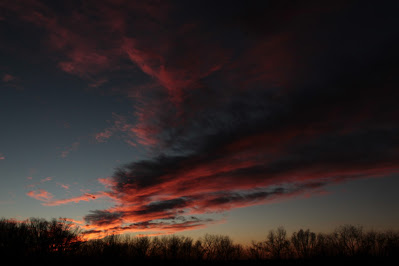
    The clouds provided a spectacular canvas for the sun to illuminate. As the sun sunk down, the sky started out with an orange tinge which slowly turned towards red. The lower the sun dropped below the horizon the deeper the color became. The tops of the clouds were dark gray, making the scene that much more dramatic!

    Turning around towards the east, the clouds were pink, looking to the south, the shades morphed into the purple range. During the next half hour or more the color show continued. I can’t remember seeing a more spectacular sky! The reds in the west were getting darker and deeper while the colors behind me started fading into grays and blacks. The edge of the western horizon stayed red long after everything went dark, silhouetting the trees. There was a bit of clearing towards the north but even with binoculars, I couldn’t see any stars yet. The clouds moved over to hide Venus and Saturn from view.

    Slowly the cloud drifted south and eventually Venus reappeared from behind it. Try as I might, I couldn’t see the comet, I felt that it had already gone below the horizon.

    I packed up my gear, accepting the fact that once again, I missed it. Behind me, hundreds of stars had appeared. I spent awhile exploring them with my binoculars. I visited the Andromeda Galaxy, almost directly overhead, the Hyades, the Pleiades and even the Coat Hanger Cluster to name just a few. I drifted through the constellations and lost myself in the beauty of the tiny dots scattered everywhere. Eventually the cold and hunger pulled me away and I headed home for dinner. When I arrived home, the moon was hanging above the eastern horizon.

    While I was searching for the comet, trying to see it through the clouds and haze I couldn’t help but think about the old Yiddish proverb, “We plan, God laughs”. Yes, I’m sure He was laughing this evening, perhaps even thinking, “I gave you that wonderful sunset, what more do you want?

    The sunset show was the definitely the highlight of the evening. The views of the stars through the binoculars before I left came close behind! I spent some time hanging out on the hillside with a couple deer. Only a few cars went by and it was nice and quiet. It was a great way to celebrate the Winter Solstice!

    My own thoughts about the comet…eh, there will be others!


A Pre-Labor Day Drive

The Labor Day weekend was in front of us and since we had no pressing obligations we decided to take a ride. After a little thought we decid...